
In automotive interior manufacturing, choosing the right Automotive Interior Adhesive Supplier is critical to preventing delamination, reducing VOC emissions, and avoiding costly assembly line downtime. For OEM and Tier 1/Tier 2 production, a supplier must provide more than just baseline bonding strength; they must deliver absolute batch-to-batch consistency, multi-material compatibility, and customized technical engineering. This B2B guide explores the technical parameters, process matching requirements, and quality control metrics necessary to evaluate and select a reliable automotive adhesive manufacturer capable of supporting long-term mass production.
Table of Contents
- The Strategic Role of an OEM Automotive Adhesive Supplier
- Evaluating Multi-Material Substrate Compatibility
- Manufacturing Process Compatibility and Line Efficiency
- Heat, Aging, and Environmental Resistance Standards
- Application Scenarios in Automotive Interior Manufacturing
- Assessing Mass Production Stability and Quality Control
- OEM Project Support and Custom Formulation Capabilities
- Conclusion
1. The Strategic Role of an OEM Automotive Adhesive Supplier
A reliable OEM Automotive Automotive Adhesive Supplier acts as a technical partner that aligns chemical formulations with specific vehicle lifecycles, ensuring uninterrupted mass production and minimizing the risk of field failures.
Modern automotive interiors are no longer simple assemblies. The integration of advanced lightweight composites, smart surfaces, and sustainable textiles has fundamentally changed how interior components are bonded. Tier 1 and Tier 2 suppliers are not simply buying chemicals; they are securing a critical component of their manufacturing supply chain.
If an adhesive fails to perform predictably on the factory floor, the resulting bottlenecks—such as extended drying times, messy overspray, or failed vacuum forming presses—can halt an entire production line. Furthermore, adhesive failures in the field lead to massive warranty claims and severe brand damage. Therefore, evaluating a supplier requires looking beyond static data sheets to assess their deep understanding of automotive manufacturing constraints, material science, and long-term supply stability.
2. Evaluating Multi-Material Substrate Compatibility
Evaluating an Automotive Adhesive Factory requires analyzing their ability to reliably bond low-surface-energy materials like PP and TPO to fabrics, foams, and PVC without chemical degradation.
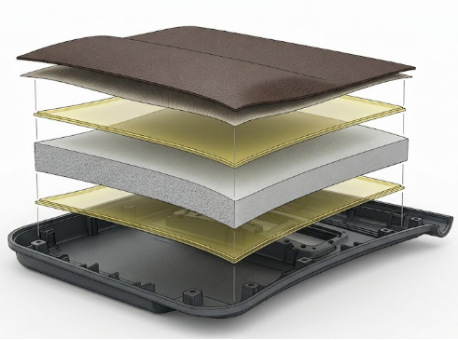
One of the greatest engineering challenges in automotive interior production is bridging the gap between divergent materials. A vehicle cabin brings together rigid structural plastics, soft-touch foams, synthetic leathers, and natural fiber boards.
A high-quality adhesive must address two primary physical challenges:
- Surface Energy: Materials like Polypropylene (PP) and Thermoplastic Olefin (TPO) are notoriously difficult to bond due to their low surface energy. Standard formulations will simply peel off. A specialized supplier engineers adhesion promoters and customized tackifiers that chemically bite into these inert surfaces without requiring aggressive, time-consuming surface pretreatments.
- Thermal Expansion Mismatch: When an ABS plastic substrate is bonded to a PVC film, the two materials expand and contract at completely different rates under the heat of the sun. The adhesive layer must possess enough elastomeric flexibility to absorb this mechanical shear stress without fracturing or causing the PVC to warp.
3. Manufacturing Process Compatibility and Line Efficiency
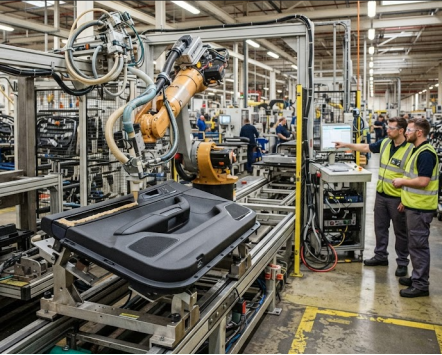
A professional supplier provides Automotive Interior Adhesive Solutions specifically tuned to your factory’s spray application, vacuum forming, or lamination processes by precisely controlling open times and activation temperatures.
Even the strongest adhesive is useless if it cannot be seamlessly integrated into your factory’s existing workflow. The rheology (flow behavior) and curing profile of the adhesive dictate the speed of your production line.
When auditing a supplier, their technical team must evaluate your equipment. For spray applications, the adhesive must atomize cleanly without clogging nozzles or creating excessive airborne overspray. For press bonding and lamination, the formulation must offer the exact “open time” required by your operators to align complex parts, while instantly achieving high green strength (initial tack) once heat or pressure is applied.
KONSENT provides automotive interior adhesive solutions designed for OEM and industrial manufacturing applications, ensuring that chemical curing profiles perfectly match the speed and mechanics of your assembly lines.
4. Heat, Aging, and Environmental Resistance Standards
High-performance adhesives must endure extreme cabin temperature fluctuations, high humidity, and continuous vibration while meeting stringent low-VOC emission standards for worker and passenger safety.
Automotive interiors represent a brutal operating environment. A vehicle parked in direct summer sunlight can see dashboard temperatures exceed 100°C (212°F), while winter nights can drop well below freezing.
Suppliers must prove their formulations possess superior heat resistance, hydrolysis resistance (protection against high humidity degradation), and overall aging resistance. If the adhesive polymer degrades under UV exposure or thermal cycling, components will inevitably sag or delaminate.
Simultaneously, the automotive industry is aggressively shifting toward sustainable manufacturing. OEMs now enforce strict limits on Volatile Organic Compounds (VOCs) to eliminate the “new car smell” associated with toxic off-gassing. A forward-thinking supplier will offer advanced water-based formulations and low-emission solvent-free technologies that meet global environmental regulations without sacrificing bonding strength.
5. Application Scenarios in Automotive Interior Manufacturing
Different interior components—such as dashboards, door panels, and decorative trims—require highly specific adhesive profiles to withstand localized stresses, complex geometries, and varied material compositions.
A versatile supplier must demonstrate proven application experience across the entire vehicle cabin:
Dashboard Manufacturing and Vacuum Forming
Dashboards often utilize vacuum forming processes to wrap PVC or TPO skins tightly over intricate ABS or PP substrates. The adhesive must activate precisely at the vacuum forming temperature, maintain a stable bond across deep draws and complex curves, and resist immense thermal stress caused by direct windshield sunlight exposure.
Door Panel Assembly
Door panels are composite structures involving fabrics, synthetic leather, acoustic foams, and rigid plastic carriers. The adhesive must dampen vibrations to prevent rattling while offering high flexural strength to endure the mechanical shock of the door slamming repeatedly over a 15-year lifecycle.
Interior Lamination and Trims
For decorative panels, headliners, and textile surfaces, the lamination process requires rapid production speeds. The adhesive must spread evenly, avoid bleed-through that could ruin delicate fabrics, and provide an immediate bond to match the speed of automated lamination rollers.
Technical Decision Matrix: Automotive Bonding Requirements
| Interior Component | Typical Materials Bonded | Manufacturing Process | Critical Adhesive Requirement |
| Dashboards | PVC/TPO skin to ABS/PP | Vacuum Forming | High heat resistance, deep-curve stability, low VOC |
| Door Panels | Fabric/Leather to PP/Foam | Press Bonding / Spray | High initial tack, vibration dampening, multi-substrate grip |
| Headliners | Textile/Foam to Fiber Board | Lamination | Zero bleed-through, rapid curing, high heat resistance |
| Decorative Trims | Wood/Metal to Plastics | Assembly | Shear strength, thermal expansion mismatch absorption |
6. Assessing Mass Production Stability and Quality Control
Partnering with a reliable automotive adhesive manufacturer for mass production ensures strict batch consistency, eliminating formulation variances that cause production line stoppages and high rejection rates.
For OEM procurement managers, the most critical buying factor is not unit price, but supply stability. If the viscosity or solid content of an adhesive fluctuates from one batch to the next, robotic sprayers will clog, vacuum presses will fail to bond, and production downtime will skyrocket.
A premier supplier implements a rigorous quality control system that tracks raw materials, validates chemical consistency across massive production volumes, and guarantees delivery stability. This reliable supply capability is what allows Tier 1 manufacturers to confidently support multi-year vehicle lifecycle contracts without fear of supply chain disruptions.
7. OEM Project Support and Custom Formulation Capabilities
Custom automotive interior adhesive solutions are essential for new vehicle platforms, requiring a supplier equipped to offer extensive material testing, application guidance, and bespoke chemical engineering.
Major automotive clients are rarely looking to buy off-the-shelf chemicals; they are looking for a technical partner. As OEMs introduce new lightweight composites or sustainable synthetic leathers, standard adhesives frequently fail.
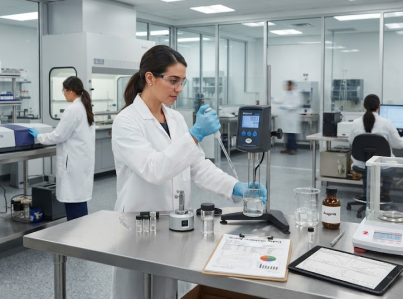
A specialized supplier distinguishes themselves through their R&D and project support capabilities. This includes conducting joint material compatibility testing in their own laboratories, offering on-site application guidance to optimize factory machinery, and developing custom adhesive formulations tailored to the exact specifications of a new vehicle model. This level of technical engagement drastically reduces the OEM’s time-to-market and minimizes manufacturing risks.
8. Conclusion
Selecting the right Automotive Interior Adhesive Supplier is a strategic decision that heavily influences product durability, factory efficiency, and brand reputation. By evaluating a supplier based on their multi-material bonding expertise, their ability to match your specific manufacturing processes, and their commitment to strict quality control, purchasing teams can eliminate the hidden costs of production downtime and warranty claims. Ultimately, the best supplier is a dedicated technical partner—one capable of providing custom formulations, reliable mass production stability, and environmental compliance necessary to thrive in the modern automotive supply chain.
At Konsent, we specialize in developing high-performance automotive interior adhesives designed for reliable bonding across various substrates, including plastics, fabrics, foams, leather, and composite materials. With extensive experience supporting automotive manufacturers and suppliers, we provide customized adhesive solutions tailored to your production requirements. Contact Konsent today to discuss your automotive adhesive needs and discover how our technical expertise can help improve your assembly efficiency, product quality, and long-term manufacturing performance.
Frequently Asked Questions (FAQs)
Why is bonding PP and TPO in automotive interiors so difficult?
Polypropylene (PP) and Thermoplastic Olefin (TPO) are low-surface-energy plastics, meaning they act somewhat like Teflon—standard adhesives struggle to “wet” or grip the surface. A specialized automotive adhesive manufacturer utilizes advanced tackifiers and adhesion promoters specifically engineered to chemically bond to these inert surfaces.
How does adhesive selection impact vehicle cabin VOC emissions?
Traditional solvent-heavy adhesives release Volatile Organic Compounds (VOCs) as they cure, which contributes to interior air pollution and the toxic “new car smell.” Leading suppliers now offer high-performance water-based adhesives and low-emission formulations to help OEMs meet strict global air quality and worker safety regulations.
Why is batch-to-batch adhesive consistency vital for OEM production?
In automated automotive manufacturing, robots are calibrated to dispense fluids at a highly specific viscosity and flow rate. If an adhesive’s formulation varies between batches, it causes nozzle clogging, uneven spray patterns, or incorrect curing times, leading to immediate production line stoppages and scrapped interior components.
What is the role of an adhesive in the vacuum forming process for dashboards?
During vacuum forming, an adhesive must activate at a very specific temperature as the heated PVC/TPO skin is pulled over the substrate. It must instantly grip the complex curves and deep recesses of the dashboard design, preventing the skin from shrinking back or lifting when the component cools or is later exposed to intense sunlight.
Can a supplier provide custom automotive interior adhesive solutions?
Yes. A professional Tier-level supplier operates dedicated R&D facilities to test new substrates, simulate factory pressing conditions, and adjust chemical properties (such as open time, activation temperature, and viscosity) to create a bespoke formulation precisely matched to a new vehicle platform’s unique requirements.
