
Selecting the right glue for cardboard boxes and folding cartons is a critical factor in packaging efficiency. Unlike complex film laminations, basic carton sealing relies on paperboard-to-paperboard bonding. However, variations in board porosity, machine speed, and surface treatments mean that a single adhesive cannot handle every folding carton application.
This guide, part of our comprehensive packaging glue guide for adhesive families and selection, explores the technical realities of carton sealing, the adhesives used, and how to match chemistry to your packaging line.
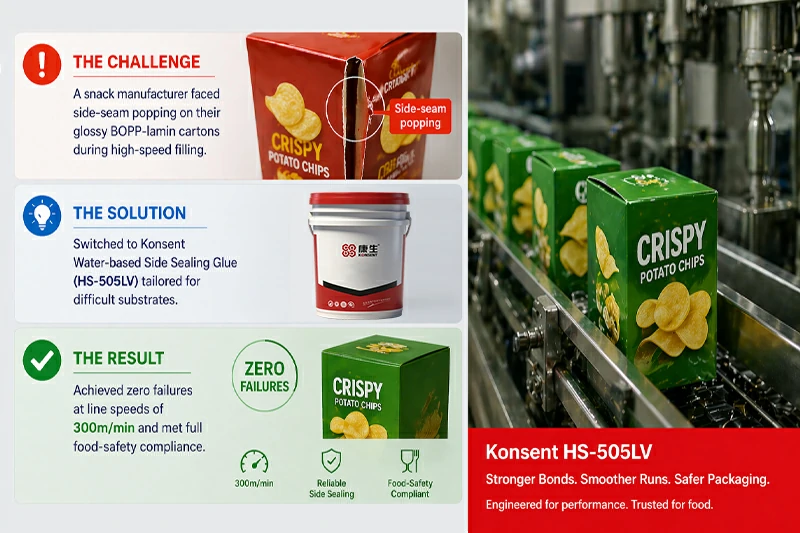
Table of Contents
- Understanding Carton Sealing Adhesion
- Adhesive Families for Folding Cartons
- Application Methods: Side-Sealing vs. End-Flap Gluing
- Substrate Variables and Adhesion
- Overcoming Coated and Decorated Boards
- Navigating Machine Speed and Viscosity
- Conclusion
1. Understanding Carton Sealing Adhesion
The primary function of a carton sealing adhesive is to penetrate the porous fibers of paperboard, creating a mechanical bond strong enough to cause fiber tear upon opening. This fundamental requirement dictates the performance metrics of the adhesive.
1.1 The Role of Fiber Tear
In paperboard packaging, a successful bond is defined by fiber tear—meaning the paper substrate fails before the adhesive line breaks. If an opened carton shows a clean layer of glue on one side and intact board on the other, the bond has failed. Achieving fiber tear requires an adhesive with the correct viscosity to wet out the surface and penetrate the board before setting.
1.2 Balancing Bond Strength and Set Time
The tension in carton sealing lies between achieving deep penetration for strength and rapid curing for line speed. High-speed case sealing requires a fast set time so the carton can be filled, closed, and subjected to spring-back forces immediately. The carton sealing glue must transition from a liquid to a solid bonding state within fractions of a second, often with minimal compression dwell time.
2. Adhesive Families for Folding Cartons
Industrial folding carton adhesive suppliers formulate different chemistries to address varying line speeds, application methods, and substrate types. Understanding these families is essential for specifying the correct glue.
| Adhesive Family | Chemistry | Strength Profile | Set Time | Best Fit in Folding Cartons |
|---|---|---|---|---|
| PVA dispersion | Aqueous polyvinyl acetate | Moderate, rigid bond | Short to medium | Hand assembly and moderate-speed lines sealing uncoated board |
| Hot melt (thermoplastic) | 100% solid EVA or metallocene copolymer | High, immediate grab | Seconds | Automated high-speed lines and coated or decorated board |
| PUR reactive hot melt | Two-component polyurethane | High, heat and solvent resistant | Seconds, with a cure period | Packaging that must survive retort, cold chain, or aggressive filling |
| Corrugated grade | Starch or high-solids PVA | Moderate, tolerates rough surfaces | Medium | Single-wall and double-wall board where appearance is not critical |
PVA is the default for a reason: it is water-based, so it cleans from equipment and hands with plain water, and it costs less per kilo than either hot melt family. PUR earns its price only where the finished box faces heat, cold, or solvents after sealing. Corrugated grade is deliberately unrefined in appearance, because the bond it creates is hidden inside the flute rather than shown on a shelf.
2.1 Polyvinyl Acetate (PVA) Dispersions
PVA adhesives, commonly known as cold glues, are water-based dispersions. They are the standard choice for untreated folding cartons due to their excellent penetration into virgin and recycled paper fibers. PVA provides a flexible, robust bond and is easily cleaned from machinery. However, because they cure through water evaporation and absorption into the board, their set time is slower than hot melts, limiting their use on the highest-speed, short-compression packaging lines unless specifically formulated for rapid tack.
2.2 Hot Melt (Thermoplastic) Adhesives
Hot melt adhesives are 100% solid, thermoplastic materials applied in a molten state. They cure almost instantly as they cool, making them the preferred chemistry for rapid case sealing and end-flap closures where compression time is virtually zero. Ethylene Vinyl Acetate (EVA) is the traditional base, offering aggressive hot tack. Metallocene-based hot melts provide cleaner running properties with less charring and stringing at high speeds, though they can struggle with highly resistant substrates.

2.3 Polyurethane (PUR) Reactive Hot Melts
PUR hot melts combine the initial fast set of a thermoplastic with a secondary chemical cross-linking cure triggered by ambient moisture. Once fully cured, PUR forms a thermoset bond that resists extreme temperatures, moisture, and chemical exposure. While more expensive and requiring specialized application equipment, PUR is utilized for high-end structural packaging or heavy-duty cartons exposed to severe shipping environments.
2.4 Corrugated-Grade Adhesives
While this guide focuses on folding cartons, heavier secondary packaging demands different adhesive properties. Corrugated boxes require adhesives that bridge the fluting gaps and withstand significant compression loads during stacking. Starch-based adhesives are often used in the corrugating process itself, while aggressive hot melts dominate the final case-sealing stage. In that structure the adhesive job changes completely, so a grade qualified for folding cartons is rarely the right choice for corrugated.
3. Application Methods: Side-Sealing vs. End-Flap Gluing
The location of the glue line on the carton dictates the volume of adhesive required, the application equipment, and the necessary physical properties of the glue.
3.1 Side-Seam Gluing Profiles
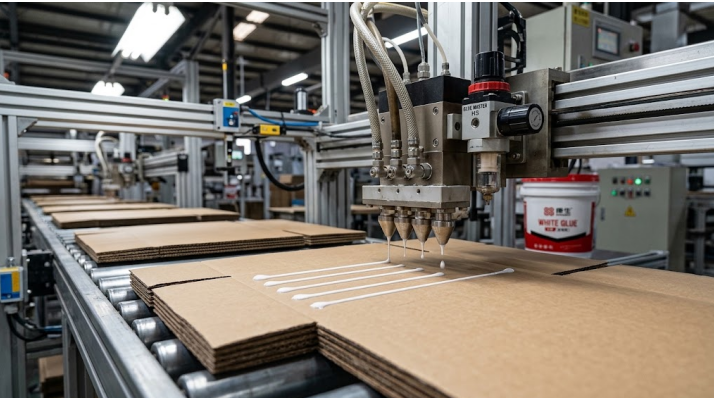
Side-sealing forms the longitudinal tube of the folding carton. This process occurs on high-speed folder-gluers before the carton is shipped flat to the filler. Because the glue line runs the entire length of the carton, it is typically applied via an extrusion nozzle or a glue wheel. The adhesive must exhibit excellent flow characteristics without stringing, as the line speed is often continuous and very rapid. A specialized laminated carton edge and side sealing glue is often required when the side seam involves complex substrate transitions.
3.2 End-Flap and Bottom-Locking Requirements
End-flap gluing happens at the filling facility. The carton is erected, filled, and the flaps are closed. This application frequently uses intermittent nozzle extrusion, placing dots or short beads of hot melt. The defining challenge here is the “memory” or spring-back of the folded board. The adhesive must have aggressive initial tack to hold the flaps closed against this tension with minimal compression time. Bottom-locking designs, common in crash-lock cartons, require precise, high-tack cold glues applied during the folder-gluer stage to ensure the complex folds hold securely.
4. Substrate Variables and Adhesion
The physical characteristics of the paperboard are the most significant variables affecting folding carton adhesive performance. Assuming all board stock acts the same is a frequent cause of line failure.
4.1 Paperboard Porosity and Sizing
Porosity determines how quickly the adhesive vehicle (water in cold glue, heat in hot melt) penetrates the fibers. Highly porous, uncoated recycled boards absorb water rapidly, potentially causing cold glues to dry out before forming a continuous film, leading to weak bonds. Conversely, highly sized virgin boards have closed surfaces that resist penetration, requiring adhesives formulated with specific wetting agents to anchor effectively.
4.2 Grain Direction Influence
The alignment of the wood fibers in the paperboard—the grain direction—affects how the board bends and how it absorbs adhesive. Folds parallel to the grain are easier to make and exhibit less spring-back, placing lower stress on the glue line. Folds perpendicular to the grain are stiffer, creating higher tension that demands an adhesive with superior hot tack or longer open time to maintain the bond during compression.
5. Overcoming Coated and Decorated Boards
Standard PVA or EVA adhesives struggle significantly when the folding carton surface is altered for aesthetic or functional purposes. These treatments fundamentally change the surface energy of the bonding area.
5.1 The Challenge of Low Surface Energy
Coatings such as UV varnish, aqueous dispersions, and polymer film laminations (BOPP, PET) lower the surface energy of the paperboard. Standard water-based adhesives bead up on these surfaces instead of wetting out, preventing mechanical anchoring. The adhesive simply dries on top of the coating, resulting in immediate bond failure upon manipulation.
5.2 Adhesives for Coated Surfaces
Bonding these difficult substrates requires specialized formulations. For film-laminated surfaces, modified acrylic dispersions or aggressive PUR hot melts are necessary. These adhesives are engineered to chemically bite into the synthetic coating or film rather than relying purely on mechanical fiber penetration. In many high-end packaging designs, the glue flap must be selectively left uncoated (spot varnished) to allow standard adhesives to work, but when this is impossible, specialized chemistry is mandatory.
5.3 Carton Window Patching Integration
A common feature in decorated folding cartons is the inclusion of a clear polymer film window. Adhering this non-porous film (typically PET or acetate) to the porous interior of the paperboard requires a distinct adhesive formulation that balances aggressive adhesion to the plastic with controlled penetration into the paper. Using the wrong adhesive here causes the window to detach or the paper to pucker. Utilizing a dedicated carton box window patching glue ensures a clean, flat bond that withstands the flexing of the carton.

6. Navigating Machine Speed and Viscosity
The mechanical realities of the packaging line dictate how an adhesive must behave in its liquid state. Line speed outrunning adhesive capability is a primary source of downtime.
6.1 Open Time and Set Time Dynamics
Open time is the window between applying the adhesive and closing the substrates. Set time is the duration required under compression to achieve a handling bond. On manual or slow lines, a longer open time is beneficial. However, on automated lines, a long open time leads to the adhesive skinning over before closure. Case sealing adhesive must be calibrated to match the specific interval between the applicator head and the compression section.
6.2 Managing High-Speed Application
As line speeds increase, the shear forces exerted on the adhesive during application rise dramatically. Adhesives not formulated for these speeds exhibit rheological instability. This manifests as stringing or “angel hair”—fine threads of adhesive pulled from the nozzle—which contaminate the packaging and foul optical sensors. Formulating a stable high-speed adhesive involves precise molecular weight control so that every strand cuts off cleanly at the nozzle.
| Line Condition | What the Adhesive Must Do | Failure If Unmatched |
|---|---|---|
| Manual or slow line, uncoated board | Hold a long open time so operators can align the flap | Skins over before closure; poor bond |
| Automated mid-speed line | Balance open time against a short set under compression | Bond starves or the box jams the compression section |
| High-speed line, coated or printed board | Stay rheologically stable under nozzle shear | Stringing and angel hair foul optical sensors |
| Cold store or low ambient temperature | Stay fluid without thinning | Gelation; lumps and gaps in the bond line |
Open time and set time are not the same number. Open time is the gap between laying the adhesive and closing the flap; set time is how long the joint must stay compressed to reach a bond strong enough to be handled. A glue can have a generous open time and still need a long press dwell.
7. Conclusion
Selecting the correct glue for cardboard boxes and folding cartons requires analyzing the interplay between substrate porosity, surface treatments, and machine speed. While standard PVA and EVA hot melts handle basic untreated paperboard efficiently, the introduction of recycled fibers, UV coatings, and high-speed automated lines necessitates specialized formulations. By matching the adhesive’s open time, set time, and chemical composition to the specific demands of the packaging line, manufacturers can eliminate bond failures, reduce machine downtime, and ensure reliable carton integrity. If you are experiencing persistent bonding issues on your packaging line, contact our technical team for a technical review of your current adhesive specifications.
FAQ
Why am I experiencing poor glue adhesion in my case sealing machines?
Poor adhesion is typically caused by a mismatch between the adhesive’s set time and the machine’s compression time, or the adhesive struggling to penetrate a highly sized or recycled board. Adjusting the application temperature (for hot melts) or switching to an adhesive with better wet-out properties usually resolves the issue.
What causes glue stringing at high line speeds?
Stringing, or “angel hair,” occurs when the adhesive lacks a clean cutoff characteristic at the applicator nozzle due to excessive viscosity or incorrect rheology under high shear. Using an adhesive specifically formulated for high-speed application, such as metallocene-based hot melts, minimizes this problem.
Why does my glued board fail on UV-coated or film-laminated surfaces?
Standard adhesives rely on penetrating the porous paper fibers. UV varnishes and polymer films create a sealed, low-surface-energy barrier that prevents this penetration. You must use specially formulated adhesives designed to adhere to synthetic surfaces or ensure the glue flap is spot-varnished to leave raw paper exposed.
How do I adjust the open time of my carton sealing glue?
Open time is primarily determined by the adhesive’s formulation. However, you can slightly adjust it on the line by modifying the application temperature of a hot melt (higher temperature generally increases open time) or by changing the volume of adhesive applied.
Can I use the same adhesive for side-sealing and end-flap gluing?
While possible on some versatile lines, it is rarely optimal. Side-sealing on a folder-gluer often utilizes precise liquid dispersions, while end-flap gluing at the filler typically requires aggressive hot melts to counteract the immediate spring-back of the folded flaps with minimal compression time.
What is the significance of fiber tear in carton sealing?
Fiber tear is the visual confirmation of a successful mechanical bond. It indicates that the adhesive has penetrated the paperboard deeply enough that the substrate itself fails before the adhesive layer does, ensuring the carton will remain sealed under stress.
