
Choosing woodworking glue by price per kilo is how a furniture factory ends up spending more than it planned. The drum price is the only number most buyers compare, and it is the least important one. Two grades that differ by USD 0.40 per kilo can differ by several thousand dollars a month once you count the glue-up rejects, the changeover downtime, and the hours your engineers spend at the glue station.
Table of Contents
- Why the Price Per Kilo Is the Least Useful Number
- The Four Woodworking Glue Families You Will Actually Compare
- What Changes When You Switch Suppliers
- Reading a Supplier’s Technical Data Sheet
- The Five Questions to Ask Before You Approve a Grade
- Where Each Family Belongs on Your Line
- What to Send When You Ask for Samples
- Trial Protocol Before You Switch the Whole Plant
- What to Ask For in the Quotation
- Why the Cheapest Grade Frequently Costs More
- Conclusion
1. Why the Price Per Kilo Is the Least Useful Number
A drum of adhesive carries a solids percentage, and two products with the same price per kilo can deliver very different amounts of usable resin. A water-based PVA at 45 percent solids carries more water per kilo than a PVA at 60 percent solids, and the water has to evaporate during cure, which means time and heat and press capacity. When a buyer compares quotes without asking for the solids figure, the comparison is not apples to apples.
Then there is the hidden cost that nobody invoices. Every glue change on a running line requires a trial run before the production run. The press sits idle while your engineer finds the right spread rate, the right press time, and the right temperature. For a large panel line that trial can consume most of a shift, and the shift has to be paid for whether or not the panels sell.
| Cost Item | Appears on the Invoice | Who Absorbs It |
|---|---|---|
| Adhesive per kilo | Yes | — |
| Freight and duty on drums | Yes | — |
| Solids percentage mismatch | No | Factory, through excess cure time |
| Trial run during changeover | No | Factory, in idle press hours |
| Glue-up rejects | No | Factory, in scrap and rework |
| Rework and re-press | No | Factory, in labour |
| Adhesive setting in the pot | No | Factory, in tank cleaning |
| Downtime if a joint fails in the field | No | Factory, in warranty and reputation |
2. The Four Woodworking Glue Families You Will Actually Compare

Most wood and panel production lines run one of four adhesive families. They differ in how they set, how they behave under moisture, and how forgiving they are when the substrate is not perfect.
PVA dispersion. Water-based, solvent-free, cleans up with water. It penetrates porous wood and particleboard, which is why it dominates cabinet carcasses, drawers, and general assembly. Its weakness is moisture resistance and its tendency to creep under sustained load in humid conditions.
EPI (emulsion polymer isocyanate). A water-based two-component system that cures with moisture and forms a bond considerably stronger than the wood itself. It is the standard choice for solid wood joinery, chairs, and anything that ships to a damp climate or gets wet in service.
PUR (polyurethane reactive). Also moisture-curing, but it crosslinks through a chemical reaction, which is why it bonds to non-porous substrates and resists heat and solvent. It costs more per kilo and requires sealed applicators so it does not cure inside the tank.
Hot melt. A 100 percent solid thermoplastic applied molten and set by cooling. It sets in seconds and dominates edge banding and high-speed wrapping, where no time exists for water to leave the joint.
| Property | PVA Dispersion | EPI | PUR | Hot Melt |
|---|---|---|---|---|
| Bonding mechanism | Water absorption and evaporation | Moisture-triggered crosslinking | Chemical crosslinking | Cooling solidification |
| Typical set time | Minutes to hours | Minutes to hours | Minutes, then further cure | Seconds |
| Moisture resistance | Low to moderate | High | High | Moderate |
| Bonds to non-porous substrates | No | Limited | Yes | Yes |
| Cleanup | Water | Water, once cured | Solvent or mechanical | Mechanical, heated tank |
| Lines it suits | Cabinet assembly, drawers | Solid wood joinery, chairs | Lamination, mixed substrates | Edge banding, wrapping |
| Relative cost driver | Volume, solids | Resin content, mixing | Resin, sealed equipment | Bulk granules, low labour |
The right family is decided by the joint, not by the adhesive. A chair joint that will see moisture wants EPI or PUR. A cabinet carcass in a dry climate is perfectly served by PVA, and moving it to a more expensive chemistry buys nothing except a larger invoice.
3. What Changes When You Switch Suppliers
A changeover looks like an order form. In practice it is a project with four stages, and the stages before production are where the time disappears.
- Sample evaluation. Someone ships your actual substrate, not a clean sample coupon. This is the stage where most suppliers look identical, because everyone passes on a coupon.
- Line trial. The grade runs on one or two lines for part of a shift while you watch bead uniformity, squeeze-out, and press time.
- Parameter setting. Spread rate, press temperature, press time, and cooling time get written down and handed to the line.
- First production run. The line runs at full speed with the new grade, and rejects are counted rather than assumed to be zero.
The stage most factories skip is the fourth. A grade that works on one line can behave differently on a faster line with a different press cycle, and the difference only shows up in the rejects.
If you are comparing grades rather than one supplier against another, the wood veneer adhesive process is where the parameters matter most, because veneer has no tolerance for a starved glue line.
4. Reading a Supplier’s Technical Data Sheet
A technical data sheet is a specification, not a promise. Four fields on it decide whether the product is worth trial time.
Solids percentage. Ask for it, compare it, and convert every quote to a solids-equivalent price. This single number often explains a price gap that looked unfair before the conversion.
Viscosity. Quoted at a stated temperature, usually 23 °C or 25 °C. If the supplier does not state the temperature, the number is not comparable to anyone else’s.
Open time and press time. These come as a range, and the range matters more than the midpoint. If your line needs six minutes and the range is four to eight, you are running at the edge on a bad day.
Storage and shelf life. A water-based adhesive stored below its minimum temperature can lose viscosity permanently. Ask what the minimum is, and ask what happens if a drum arrives after a cold transit.
5. The Five Questions to Ask Before You Approve a Grade
Once you have two or three candidate grades, these are the questions that separate them.
- What is the solids percentage, and what is the dry coat weight you have qualified at our spread rate?
- At what temperature is the viscosity quoted, and what is the acceptable range on arrival?
- What is the qualified spread rate in grams per square metre for each of our substrates?
- What press time and press temperature did you qualify at, and on which press?
- If the grade drifts outside that window on the next batch, what does your technical support do about it?
The fifth question is the one that separates a manufacturer from a trading company. A manufacturer has a process engineer who can come to your line, and a batch record behind every drum they ship. A trading company has a price list and an email address.
This is not a small distinction when a grade drifts outside its qualified range. KONSENT was founded in 2011 in Dongguan and runs 10, 20, and 50-ton Siemens DCS automated lines with a core capacity of roughly 100,000 tons per year, dosing raw materials from Kuraray, Chang Chun, Celanese, Wacker, BASF, and Covestro under ISO 9001 with REACH and RoHS documentation. Those numbers matter for one practical reason: a manufacturer can show you the batch record for the drum that caused the problem, and a reseller cannot. Technical response runs seven hours a day, twelve days a week, so a drift on your line is answered the same day.
For a broader view of how these families map onto specific furniture processes, the woodworking and furniture adhesives overview covers the full range.
6. Where Each Family Belongs on Your Line
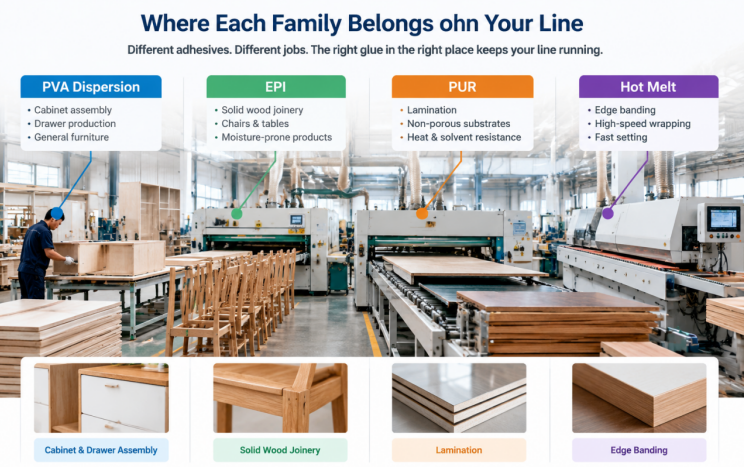
Most factories end up running more than one chemistry, and the reason is that different steps have genuinely different requirements.
- Cabinet carcasses and drawer assembly usually run PVA, because the joint is simple, the substrate is porous, and the volume is high.
- Solid wood joinery and seating usually run EPI, because those joints see moisture and load in service.
- Laminating and mixed-material work usually run PUR, because the substrate is not uniformly porous and the finished piece sees heat.
- Edge banding and high-speed wrapping usually run hot melt, because there is no time for anything else at that line speed.
Trying to run one adhesive across all four steps is the most common cost mistake in this industry. The single chemistry that works everywhere does not exist, and the grade that does everything well is expensive and slow.
7. What to Send When You Ask for Samples
The quality of the trial depends almost entirely on what arrives with the sample. Send three things: a piece of your actual substrate, a photograph of the joint you are trying to bond, and a short note about the press cycle and line speed. Suppliers who can return a trial recommendation with those three inputs are worth a conversation; suppliers who ask for a coupon are telling you they will qualify a product you do not buy.
Give them your adhesive history too. If the previous grade failed by edge delamination, that single sentence saves a trial cycle that would otherwise be wasted on a repeat of the same mistake.
If you want a starting reference point for what the main application categories look like, the MDF glue process
covers the substrate that causes the most trouble in panel production, and edge banding adhesive covers the line where set time is measured in seconds.
8. Trial Protocol Before You Switch the Whole Plant
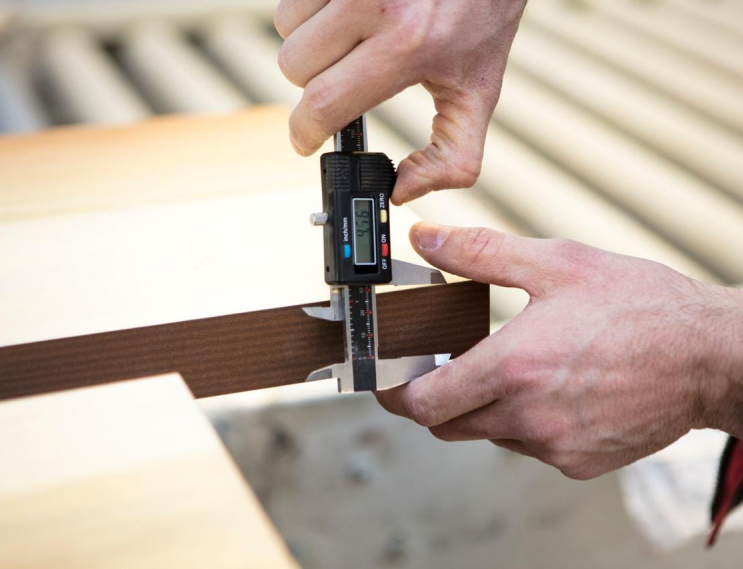
Do not run a new adhesive on every line at once. Run it on one line for half of a production day, and measure four things rather than forming an impression.
- Bead uniformity. Take a panel from the start, middle, and end of the trial run and compare them side by side.
- Squeeze-out. Measure it. If glue is coming out at the edges, the spread rate is too high regardless of how good the bond looks after cure.
- Press time. Note the shortest press time that produces a passing bond, not the longest the supplier suggests.
- Re-check after 24 hours. A bond that looks fine off the press and fails the next morning was under-cured, and no amount of press heat will fix it on the next run.
Keep the samples. When the first production run happens two weeks later, you want the trial panel and the production panel in the same hand.
9. What to Ask For in the Quotation
A quotation that contains only the drum price is not usable for comparison. Ask for these seven items in writing before you compare anything.
- Solids percentage and dry coat weight
- Minimum order quantity per formulation
- Lead time for a first trial order versus a repeat order
- Payment terms and Incoterms, and who bears freight and duty
- Whether a retained sample from every batch can be provided
- Shelf life and storage temperature limits
- Whether technical support is included in the price or billed separately
Item seven is where the difference shows up. Many suppliers will send an application engineer for a trial and then charge for the support once the grade is approved. Get that in writing before the trial.
10. Why the Cheapest Grade Frequently Costs More
The arithmetic is straightforward once you have the four numbers that matter: spread rate in grams per square metre, reject rate in panels per thousand, press minutes per cycle, and changeover hours per year.
A grade that costs USD 0.40 more per kilo and saves 0.2 percent on rejects pays for itself at most furniture lines. A grade that needs ten extra press minutes per cycle to reach the same bond strength never pays for itself at all, because press capacity is the constraint that limits how many panels you can ship.
That is the whole argument. The cheapest drum is rarely the cheapest woodworking glue, and the most expensive one is rarely justified either. The grade that fits your joint, your substrate, and your press cycle is the economical one, and finding it requires asking the seven questions above rather than comparing three prices.
Conclusion
Woodworking glue is a production decision disguised as a purchasing decision. The family you choose sets your press cycle, your reject rate, and your changeover schedule, and all three cost more than the adhesive itself. Specify by process, qualify with your own substrate, and compare quotations on solids-equivalent terms. If you want a starting point for a specific application, send us the substrate description and the joint geometry and our technical team will come back with a trial recommendation rather than a price list.
FAQ
Is PVA wood glue strong enough for furniture production?
For cabinet carcasses, drawers, and general indoor assembly, PVA produces a bond stronger than the substrate itself in a short time. It becomes the wrong choice when the joint sees standing moisture or sustained load in humid conditions, because it creeps. Strength alone is rarely the limiting factor; moisture exposure is.
How much more does EPI cost compared with PVA?
EPI carries a higher resin cost and needs two components mixed at a controlled ratio, so the adhesive price is higher and there is a metering cost on top. In exchange it cures to a bond that does not creep and tolerates moisture. On solid wood joinery that ships into damp climates, the resin premium is usually smaller than the cost of warped returns.
Can I run a PUR adhesive in an open tank?
No. PUR cures on contact with moisture, so an open tank will partially skin over during storage and the remaining material will thicken. PUR requires a sealed applicator with nitrogen purge or an equivalent dry environment. If your line cannot be sealed, PUR is not a practical upgrade.
How long can a water-based adhesive drum be stored?
Unopened, most water-based wood glues specify six to twelve months from the manufacturing date. The real limit in transit is temperature, not time. If adhesive arrives after sitting in a cold container or warehouse, ask the supplier to test the viscosity and confirm it is still inside the qualified range before you load it into the line.
Is hot melt glue suitable for structural furniture joints?
Hot melt sets by cooling, which makes it extremely fast but does not make it structural in the way EPI or PUR can be. It is the standard choice for edge banding and wrapping, where the bond is formed between two surfaces already in close contact. For a mortise and tenon or a load-bearing joint, use a crosslinking adhesive.
What information does a supplier need to recommend a grade?
Three things: the substrate in detail, the joint geometry including whether it is a face joint or an edge joint, and the press or line conditions including cycle time and temperature. With those three answers you get a specific recommendation. Without them you get a general product range, which tells you nothing about whether that product survives on your line.
How do I know whether a joint failed because of the glue or the process?
Most line-side failures that look like adhesive failures are actually process failures. Check the pattern first: a failure at the same position on every panel points at the applicator or the press, while scattered failures point at consistency. Then measure spread rate against the qualified figure, and measure press time against the qualified figure. If either is off, the adhesive may not be the cause at all.
Does solid content really affect the cost comparison?
Yes, and it is often the largest single factor. Converting every quotation to a solids-equivalent price, meaning the cost per kilo of actual resin rather than the cost per kilo of liquid, frequently shows that the more expensive drum delivers more adhesive per kilo of resin and is therefore the cheaper option in practice.
