
On a bill of materials, packaging glue is a single line. On the factory floor, the wrong one shows up as a returned pallet, a scrapped production run, or a container held at customs. The failures below are the ones buyers tell us cost them the most — and every section of this guide is built to help you avoid them:
- Cartons pop open after shipping — the glue never bit into a coated, UV-varnished, or recycled board, or it crept off in a hot, humid warehouse. For Chinese exporters shipping to the EU and US, opened flaps are a leading cause of chargebacks and angry overseas buyers.
- Frozen or refrigerated boxes crack open — a standard hot melt went brittle at -18°C, or a water-based glue re-emulsified in the cold-chain truck.
- Laminate tunnels or the print mottles — wrong coat weight, wrong mixing ratio, or a film whose surface energy the adhesive could not hold.
- The line jams at 300 m/min — stringing, tailing, and nozzle blockages that stop a high-speed cartoner cold.
- The shipment is rejected at port — no Declaration of Compliance, no migration testing, or an adhesive that will fall foul of the EU’s PPWR recyclability rules after 2030.
If any of those is your current problem, you do not need a thicker glue — you need the right chemistry matched to your substrate, your machine speed, and your market’s compliance bar. This guide gives procurement managers, packaging engineers, and converters the framework to choose, then points you to the deep-dive articles and product pages where you need them.
Table of Contents
- What Is Packaging Glue? Match the Family to Your Failure Mode
- Adhesive Family Comparison Table
- Scenario Quick-Reference: Choosing Glue by Packaging Type
- Compliance & Certifications Buyers Must Check
- Sourcing Wholesale: MOQ, OEM, and Technical Support
- Conclusion
1. What Is Packaging Glue? Match the Family to Your Failure Mode
Every packaging adhesive is a trade-off between open time, set speed, temperature resistance, and what it can bond. Pick by the failure you are trying to prevent — not by the catalog description.
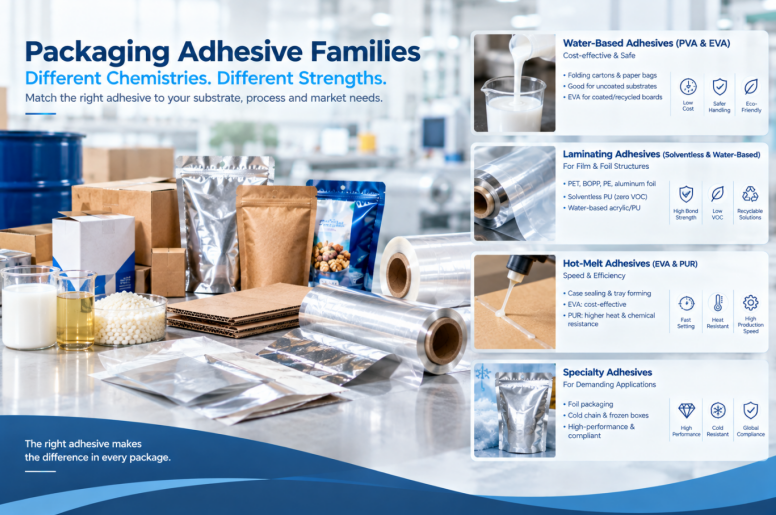
1.1 Water-Based Adhesives (PVA & EVA) — cheap, but only on the right board
Water-based adhesives disperse polymer resins in water; the bond forms as the water leaves and the particles fuse. They are the lowest-cost option and the safest to handle, which is why they dominate folding cartons and paper bags.
The trap: a standard PVA will not wet out a UV-varnished, coated, or laminated board, and it struggles with recycled board whose dust layer blocks contact with the fibers. The water flashes off before the glue penetrates, so you get a seam that is dry but not stuck — and it pops open a day later. Cold glue also creeps and peels in hot, humid plants (think Southeast Asia, coastal China, tropical Latin America, where ambient humidity runs above 70%): the bond softens and the flap edge lifts overnight. For varnished, printed, or recycled cartons you need a high-penetration EVA emulsion; KONSENT HS-8339 is formulated to bite through complex varnish and dusty recycled surfaces. Budget for a longer compression time than you would allow with hot melt, and keep the glue-pot temperature to spec — EVA carton glue wants roughly 150–170°C, and operators who “turn it down because it’s hot” cause exactly the charring and weak bonds they were trying to avoid.
1.2 Laminating Adhesives (Solventless & Water-Based) — for film and foil structures
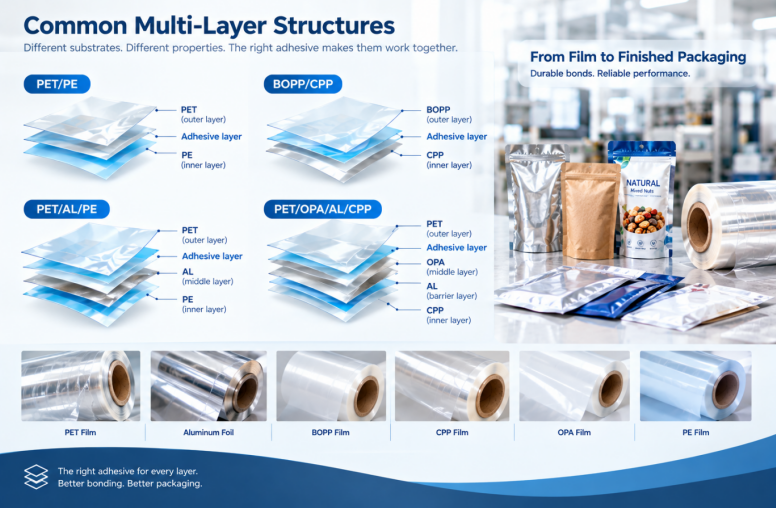
Laminating adhesives bond two or more flexible layers — PET, BOPP, PE, aluminum foil — into the multi-layer pouches and lids that food and pharma live in. Solventless two-component polyurethane systems cure by chemical reaction (isocyanate + polyol), carry zero VOCs, and need no drying oven, which cuts both energy cost and floor space. Water-based laminating adhesives use acrylic or PU dispersions for dry lamination.
The trap is no longer just technical — it is regulatory. Under the EU’s PPWR (Regulation 2025/40), most conventional PET/aluminium/PE and metallised-OPP laminates fall below the recyclability Grade C floor, and from 2030 only Grades A/B/C may be placed on the EU market (A/B only from 2038). That pushes converters toward mono-material PE or PP structures and low-monomer, aliphatic, PFAS-free polyurethane adhesives. You also must verify the film’s dyne level (surface tension) before coating — a 38-dyne BOPP will reject an adhesive a 42-dyne film accepts — and control primary aromatic amine (PAA) migration to below 0.01 mg/kg before the roll leaves the plant. For cure schedules, coat-weight windows, and the PPWR-ready route, read the dedicated BOPP/PET film lamination guide.

1.3 Hot-Melt Adhesives (EVA & PUR) — speed, until the temperature swings
Hot melts are applied molten and set as they cool, which is why they own end-of-line case sealing and tray forming. EVA hot melt is the cheap workhorse: fast set, easy to run. The trap: standard EVA goes brittle below freezing and softens in summer container heat, so a single grade rarely survives a year of seasonal shipping. PUR hot melt cures a second time with ambient moisture into a bond that shrugs off both cold-chain and desert heat — at a higher cost, and with the requirement of hermetically sealed applicators to stop it curing in the tank.
Two numbers frame the decision. Cost: PVA cold glue runs about USD 0.8–1.8/kg, EVA hot melt 2.5–5/kg, PUR 8–15/kg — but a hot-melt station costs USD 15,000–60,000 against USD 500–2,500 for cold-glue nozzles, so below 120 m/min on porous board, cold glue is usually the smarter spend. Temperature: for frozen-food and refrigerated logistics you need a freezer-grade PO or metallocene hot melt that stays flexible to -40°C — a standard low-softening-point EVA will crack in the -18°C container.
1.4 Starch and Cold-Set Adhesives — rock-bottom cost, rock-bottom limits
Starch adhesives are bio-based and nearly free; they gelatinize with heat during corrugating to lock the fluting to the liner. The trap: almost no water resistance and a rigid, slow bond — fine inside a box plant, useless for coated paper, flexible film, or anything that sees humidity. This is also why the classic “cost-cut” mistake backfires: a documented 2025 case saw a Ningbo small-appliance exporter switch from water-based PU to cheap starch glue on UV-coated cartons with shortened compression time — and ship opened lids to Europe and the US. The saving on glue was dwarfed by the returns.
2. Adhesive Family Comparison Table
Use this to shortlist, then go to the scenario section to confirm against your actual line.
| Family | Best at | Fails when | Watch for |
|---|---|---|---|
| Water-Based (PVA/EVA) | Folding cartons, paper bags, coated board; lowest cost, safe handling | Substrate is coated/UV-varnished/recycled and glue can’t penetrate → pop-opens; creeps in >70% RH heat | Longer compression time; pot temp ~150–170°C; viscosity must stay consistent on high-speed wheels |
| Solventless Laminating (PU) | Flexible pouches, foil structures, snack packs; zero VOC, no oven | Coat weight or mixing ratio off → tunneling; film dyne too low; PAA/PFAS non-compliant for EU | 24–48h cure before converting; PAA <0.01 mg/kg; PFAS-free for PPWR |
| Hot-Melt (EVA) | End-of-line sealing, case & tray packing; fastest set | Cold-chain brittle / summer re-melt; stringing at high speed | Grade must match climate; tank temperature control |
| Hot-Melt (PUR) | Difficult plastics, luxury boxes, extreme climates | Premature cure in non-sealed tank; higher $/kg; EUR 8–15/kg | Sealed applicator required; moisture cure needs humidity |
| Starch / Cold-Set | Corrugated board manufacture, tube winding | Any moisture or coated substrate | Poor water resistance; rigid bond only |
3. Scenario Quick-Reference: Choosing Glue by Packaging Type
The same phrase “packaging glue” means four different products depending on what you are running. Start from the pain you are already seeing. For the full map of packaging and printing applications we support, see our industry applications overview.
3.1 Laminated Films (BOPP/PET) — your pouches tunnel, or they won’t be recyclable in 2030
Flexible packaging glues low-surface-energy films that standard carton adhesives cannot hold. Prioritize a solventless PU system for optical clarity and chemical resistance against oils and spices — but specify a low-monomer, aliphatic, PFAS-free grade so the structure survives both EU migration limits and the PPWR recyclability gate. Mandatory pre-step: dyne-level test the film. If your laminate is already failing in the field, send us a roll sample and we will check coat weight, cure, and dyne level against the schedule. For cure windows and troubleshooting, read the BOPP/PET film lamination guide.
3.2 Folding Cartons & Cardboard Boxes — cartons pop open, wheels tail, or they fail overseas
If your cartons are coated, printed, UV-varnished, or made from recycled board, a generic PVA will not penetrate in the milliseconds before the compression belt releases — and a humid, hot warehouse will finish the job overnight. Use a water-based EVA emulsion; for heavy varnish or dusty recycled stock, specify a high-penetration grade like KONSENT HS-8339. Hold viscosity tight to kill tailing and splashing on the wheel. Above roughly 200 m/min, cold glue simply cannot develop bond strength before the substrate leaves the compression zone — that is why hot melt accounts for over 70% of adhesive on carton erectors running above 150 m/min. For pop-open root-cause and board-specific selection, see folding carton & cardboard box sealing. If you are already shipping opened cartons to overseas buyers, send us a failed sample — we diagnose coating vs. compression vs. chemistry and recommend a matched grade.
3.3 Food-Safe Packaging — customs blocks the container, or PPWR blocks the shelf
The moment packaging touches food, the decision stops being mechanical and becomes regulatory. Most applications are indirect contact (a functional barrier like a film sits between glue line and food), but you still need a Declaration of Compliance proving the formulation uses only permitted substances, plus third-party migration testing — the US FDA 21 CFR 175.105 caps component migration at 50 parts per billion, and EU 10/2011 sets Specific and Overall Migration Limits. Compliance documentation is now a standard requirement in converter procurement tenders, not a nice-to-have. KONSENT product lines are built without restricted phthalates, heavy metals, or PFAS. Exporting to the EU or US? Request our compliance pack (DoC + migration tests + PAA/PFAS declarations) before you commit volume.
3.4 Rigid & Luxury Gift Boxes — wrap wrinkles, box warps, scrap climbs
Luxury boxes wrap specialty paper around rigid chipboard, and any wrinkle or warp is a reject. Jelly Glue (protein-based) gives high initial tack with long open time so operators and auto-wrappers fold cleanly, then dries flat to stop warping. In a recent cosmetics gift-box trial, moving from standard EVA to a targeted KONSENT Jelly Glue cut scrap by 40%. See the full product range in our packaging & printing adhesives.
3.5 High-Speed Carton Lines — glue strings, jams, line stops at 300 m/min
Above roughly 300 m/min the application physics change: standard glues string at the nozzle, tail, and jam the wheels. You need a low-viscosity, fast-breaking formula — KONSENT HS-505LV is built for extrusion systems and cuts clean at the nozzle without stringing. It is validated on Valco Melton and Robatech applicators; one food folding-carton line ran zero failures at 300 m/min on engineered KONSENT formulations, and the right grade can pull carton-closing rejects from about 2% down to 0.1% on a 300-carton/min line. Explore compatible grades in our packaging & printing adhesives.
4. Compliance & Certifications Buyers Must Check
A non-compliant adhesive does not fail on the line — it fails at the border, or off the shelf after 2030. Before any bulk purchase, collect the documents below; “it looks food-safe” is not a defense at customs.
4.1 FDA 21 CFR 175.105 (Indirect Food Contact)
The FDA does not “approve” an adhesive product. It lists the permitted substances; the manufacturer certifies the formulation is made only from those, with component migration capped at 50 ppb. Your job: keep a functional barrier between glue line and food, and hold the manufacturer’s Declaration of Compliance. Buy on the substance list, not on a salesman’s “FDA approved” claim.
4.2 EU 10/2011 Regulation
Selling into Europe? This is stricter than FDA and is built on migration limits — Overall (OML) and Specific (SML). Cured adhesive must not let unreacted monomers or primary aromatic amines (PAAs) migrate into the food simulant in lab testing, and the bar is tightening: PPWR-era specifications now expect PAA below 0.01 mg/kg and isocyanate monomer below 0.1%. Aliphatic PU laminating adhesives are usually the route to passing.
4.3 PPWR, PFAS, REACH and RoHS — the new 2030 gate
Three rules now shape adhesive choice for the EU. PPWR (2025/40) forces recyclable or mono-material structures and will block most conventional multilayer laminates from the EU market from 2030. PFAS restrictions (effective August 12, 2026) cap any single PFAS at 25 ppb and total fluorine at 50 ppm in food-contact packaging — a direct reformulation trigger for high-performance laminating adhesives. REACH (EU) caps Substances of Very High Concern (SVHC), and RoHS restricts lead, mercury, cadmium, and hexavalent chromium, now routinely demanded for electronics and consumer-goods packaging at global customs. Mineral-oil restrictions (MOAH/MOSH, roughly 0.5–2 mg/kg) add a raw-material-screening burden. All of it needs supplier documentation — no document, no clearance.
4.4 ISO 9001 and Batch Consistency
Compliance papers are worthless if batch 47 behaves differently from batch 12. ISO 9001 means the supplier has locked raw-material inspection, batch testing, and traceability — which is what keeps viscosity and bond strength stable so your line does not randomly jam. This is also your defense against the most common sourcing trap: a sample that passes and mass production that fails. Insist on a Certificate of Analysis with every batch and a contracted 3-month notice before any formulation change. For export shipments, ask the supplier to state which declaration of compliance and migration testing reports will travel with each delivery, and put that in the purchase order rather than trusting it to memory.
5. Sourcing Wholesale: MOQ, OEM, and Technical Support
Buying in bulk moves the risk from chemistry to logistics, consistency, and trust. The pitfalls are predictable — and the difference between a manufacturer and a trading company matters more than the unit price.
5.1 Bulk Sourcing and Incoterms
Adhesives ship in 20 kg buckets, 200 kg drums, or 1000 kg IBC totes; custom formulations usually start at a 1–2 metric-ton MOQ. Agree Incoterms (FOB / CIF / DDP) so you know who owns freight, insurance, and clearance. Then plan for the climate: water-based glue freezes and is ruined in winter transit; hot melt can block (fuse) in summer heat. A “great price” that arrives as a frozen slab or a drum of solidified glue is not a saving. Raw-material volatility is the quiet risk here — VAM and EVA shortages through 2023–24 extended lead times across the industry, and MDI prices swung roughly 30% in a single year — so lock price bands in an annual agreement rather than chasing spot quotes. That agreement should also name the Incoterm, the freight responsibility, and who pays duty, because those three items decide whether a quoted price survives the voyage.
5.2 OEM and Private Labeling
Distributors and regional suppliers frequently sell under their own brand. KONSENT runs OEM and private-label programs: custom formulations tuned to your climate or machine speed, branded TDS, and confidential manufacturing agreements that protect your market. You get the chemistry without building a reactor.
5.3 Technical Support, Samples, and Why a Manufacturer Beats a Trader
An adhesive is only as good as its application. A half-degree of nozzle temperature or a point of humidity can flip a perfect glue to a failure. Expect — and demand — preliminary lab testing: ship your actual printed board or film to the supplier for peel, shear, and dyne-level evaluation (for example, KONSENT HS-5699 for difficult plastics), then on-site or remote support during the first line trial to dial in coat weight and compression. This is also where supplier structure decides your risk. Trading companies add layers that hide formulation changes and factory switches — the same product name can drift in performance between shipments. A manufacturer issues per-batch COA and full traceability, answers technical questions directly, and flags any formulation change 3 months ahead. Ask each supplier directly who owns the blending tanks, whether they can retain a sample from every batch, and what lead time applies to a first trial order rather than a repeat order. If you want a qualified, dual-sourced, manufacturer-direct supply plan with batch records, talk to our technical team.
6. Conclusion
The right packaging glue is the one matched to your substrate, your machine speed, and your market’s compliance bar — chosen before the line runs, not after the returns land. Whether you need a high-penetration EVA for varnished cartons, a solventless PU that clears PPWR and PAA limits for film laminates, a freezer-grade hot melt for the cold chain, or a Jelly Glue that cuts luxury-box scrap by 40%, the formulation decides your scrap rate, your clearance rate, and your chargeback rate alike.
If you are fighting pop-opens, delamination, frozen-box cracks, line jams, or a customs hold — or simply sourcing bulk glue globally — contact our technical team for substrate testing, sample formulations, and a wholesale quote matched to your line.
FAQ
Why do my folding cartons pop open 24 hours after sealing?
Almost always a surface-energy mismatch: the board is coated, UV-varnished, or recycled and a standard PVA never penetrated the fibers before the water flashed off — or the bond crept in a hot, humid store. Switch to an aggressive EVA emulsion built to bite through varnish and dusty recycled stock (KONSENT HS-8339), keep the glue-pot at ~150–170°C, and verify your compression time matches the glue’s set profile.
Why do my frozen or refrigerated cartons crack open in the cold chain?
Standard EVA hot melt embrittles below freezing and water-based glue re-emulsifies near 0°C — both fail in a -18°C container. Specify a freezer-grade PO or metallocene hot melt rated to -40°C. A quality grade should hold ≥90% fiber tear at 0–40°C after 24h cure; a cheap one clean-peels at 5°C. Tell us your lowest transit temperature and we will spec a matched freezer grade with low-temperature peel data.
My laminate tunnels and the print mottles — what changed?
Coat weight, mixing ratio, or film dyne level. Solventless PU laminates are sensitive to all three; a shift of a tenth of a gram per square meter, or a film that dropped below roughly 38 dynes, produces tunneling. Re-test film surface tension and re-validate coat weight against the cure schedule.
Will my flexible laminate still be legal to sell in the EU after 2030?
Only if it meets PPWR recyclability Grade A, B, or C (A/B from 2038) and avoids PFAS and excess PAA. Most conventional metallised or aluminium-containing structures fall below the Grade C floor today, pushing converters to mono-material PE/PP with low-monomer, PFAS-free adhesives. Plan the switch now — requalification lead time is long.
Can one hot-melt grade survive both winter and summer shipping?
Not a standard EVA — it brittles below freezing and softens in heat. Many plants swap winter/summer grades, or move to PUR hot melt, which withstands wide temperature swings after its moisture cure. For cold-chain, choose a PO/metallocene freezer grade instead.
What viscosity do my applicator nozzles actually need?
Viscosity (centipoise) governs clean cut-off. High-speed extrusion heads like Valco Melton need low-viscosity grades (for example, KONSENT HS-505LV) to avoid stringing and nozzle clogging; too thick and you get jams and line stoppages. Always ask a supplier for SAFT and low-temperature peel data — not just viscosity.
Is PVA glue waterproof?
Standard PVA is not. For refrigerated or outdoor boxes, specify cross-linking water-based or move to hot melt.
What is Jelly Glue and why is it the luxury-box standard?
A protein adhesive, solid at room temperature, that melts for application. High tack plus long open time lets operators wrap rigid boxes cleanly; it dries flat so the board does not warp. It is why premium cosmetics and spirits boxes stay wrinkle-free.
Do I need a drying oven for solventless laminating adhesive?
No. It cures by chemical reaction between two components, not by evaporating a solvent — which is exactly why it saves floor space, energy, and helps you hit PPWR recyclability targets.
How do I prove an adhesive is food-safe to customs?
You cannot test it on the floor. Require a Declaration of Compliance from the manufacturer confirming the formulation uses only permitted substances (FDA 175.105 or EU 10/2011) and third-party migration test results. No DoC, no clearance.
My sample passed but mass production failed — why?
Batch-to-batch variability: a one-off lab sample does not prove a supplier’s process control. Insist on per-batch COA, full raw-material traceability, and a contracted notice before any formulation change. A manufacturer with documented change management will give you that; a trading company often cannot.
