
Producing defect-free multi-layer packaging films requires absolute precision in chemical selection. When laminating low-surface-energy substrates like BOPP (Biaxially Oriented Polypropylene) and PET (Polyethylene Terephthalate), selecting the wrong adhesive formulation instantly results in tunneling, curling, or catastrophic delamination during shipping. As a critical component discussed in our broad packaging glue guide for adhesive families and selection, the specific laminating adhesive chosen dictates the optical clarity, chemical barrier performance, and operational line speed of the final flexible pouch. This technical guide breaks down the core differences between water-based, solvent-based, and solventless laminating adhesives, providing packaging engineers with a clear framework for substrate matching, coating weight optimization, and regulatory compliance.

Table of Contents
- The Engineering Challenge of Film Lamination
- Core Adhesive Technologies Evaluated
- Technical Comparison: Coating Weights and Cure Schedules
- Substrate Matching: BOPP, PET, and Multi-Layer Structures
- Regulatory Compliance and PPWR Recyclability
- Quality Control Variables on the Lamination Line
- Conclusion
1. The Engineering Challenge of Film Lamination
Unlike porous materials that absorb liquids to create a mechanical lock, plastic films are entirely non-porous. Adhesion must occur through chemical bonding and intermolecular forces at the microscopic surface level. This dynamic makes flexible film lamination vastly different from other converting operations.
While standard carton converting relies on fast-setting paper packaging adhesive for converting and laminating that penetrate paper fibers, film lamination requires adhesives that wet out perfectly flat across a smooth, impermeable polymer surface. The primary technical hurdle is surface energy, measured in dynes. Adhesives cannot bond to a substrate if the liquid’s surface tension is higher than the film’s surface energy. For optimal wet-out, the film must maintain a dyne level of approximately 38. If the film drops below this threshold due to additive migration (such as slip agents migrating to the surface during storage), the adhesive will bead up, causing severe delamination and optical distortion.
2. Core Adhesive Technologies Evaluated
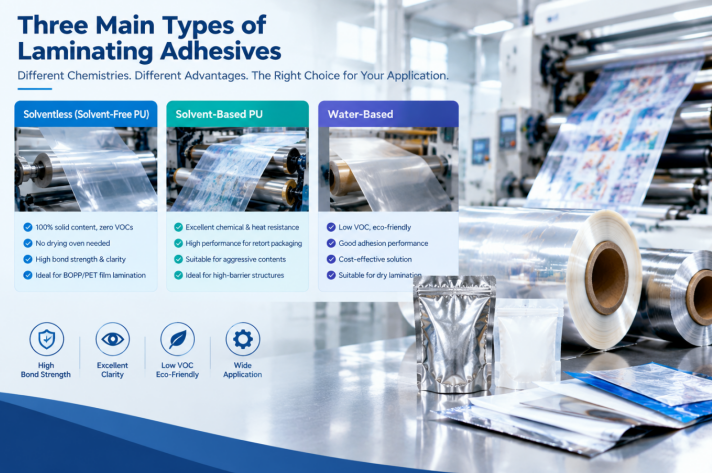
Industrial film lamination relies on three distinct chemical pathways to achieve a bond. The choice between solventless, solvent-based, and water-based systems dictates the design of the lamination machine, the energy consumed by the factory, and the end-use performance of the packaging.
2.1 Solventless (Solvent-Free PU) Systems
Solventless adhesives are two-component polyurethane systems consisting of an isocyanate (NCO) prepolymer and a polyol (OH) resin. Because they contain 100% active solids and zero volatile organic compounds (VOCs), there is no carrier fluid to evaporate.
The two components are pumped dynamically, mixed at the lamination nip, and rely on a chemical cross-linking reaction to cure. Solventless technology has become the global standard for light-to-medium performance packaging due to its massive operational advantages. It completely eliminates the need for 30-meter heated drying ovens, slashing factory energy consumption and reducing fire risks. For high-volume operations producing standard retail bags, exploring modern adhesive for flexible packaging pouches and films reveals how solventless systems maximize production throughput.
2.2 Solvent-Based Polyurethane Lamination
Solvent-based adhesives utilize ethyl acetate or similar solvents as a carrier fluid to deliver the polyurethane solids onto the film. Once applied, the web must pass through high-velocity hot air ovens to evaporate 100% of the solvent before the secondary film is nipped to the adhesive layer.
Despite the environmental and energy drawbacks of handling VOCs, solvent-based adhesives remain mandatory for high-performance applications. They offer unmatched chemical resistance and thermal stability. When manufacturing retort pouches (which are boiled in autoclaves to sterilize food) or packaging highly aggressive contents like spicy oils, liquid soaps, or agricultural chemicals, the aggressive cross-linking and high molecular weight of solvent-based PU provide the only guaranteed barrier against delamination.
2.3 Water-Based Dispersions
Water-based laminating adhesives suspend acrylic or polyurethane polymers in a water carrier. Similar to solvent-based systems, they require drying ovens to remove the water prior to the lamination nip (dry bond lamination).
These systems offer a VOC-free alternative for operators who possess drying ovens but want to eliminate the fire hazards and emissions associated with solvent-based chemistry. While water-based options provide excellent optical clarity and are highly suitable for standard snack food packaging, they require significantly higher oven temperatures to evaporate water compared to ethyl acetate, and they generally offer lower heat and chemical resistance than their solvent-based counterparts.
3. Technical Comparison: Coating Weights and Cure Schedules
Applying the correct amount of adhesive—the coating weight—is critical. Too little adhesive starves the bond and causes weak peel strength; too much adhesive traps micro-bubbles, distorts the film, and wastes money. Because solventless adhesives do not lose mass to evaporation, their applied weight equals their dry weight.
| Technology | Typical Coating Weight | Cure Schedule | Best Application Scenario |
|---|---|---|---|
| Solventless PU | 1.2 – 2.5 g/m² | 24–48 hours at 35–45°C | Standard snack pouches, dry goods, frozen food wrappers |
| Solvent-Based PU | 2.5 – 4.5 g/m² (dry) | 3–14 days (ambient or heated) | Retort pouches, aggressive chemicals, hot-fill liquids |
| Water-Based | 1.5 – 3.0 g/m² (dry) | Immediate to 24 hours | Confectionery wrappers, paper-to-film lamination |
Cure schedules are equally vital. Solventless adhesives do not achieve their final bond strength on the machine. The laminated rolls must be stored in temperature-controlled curing rooms (typically 35–45°C) for 24 to 48 hours to allow the polyurethane cross-linking to finish. Attempting to slit or form pouches before the cure cycle completes will result in immediate structural failure.
4. Substrate Matching: BOPP, PET, and Multi-Layer Structures
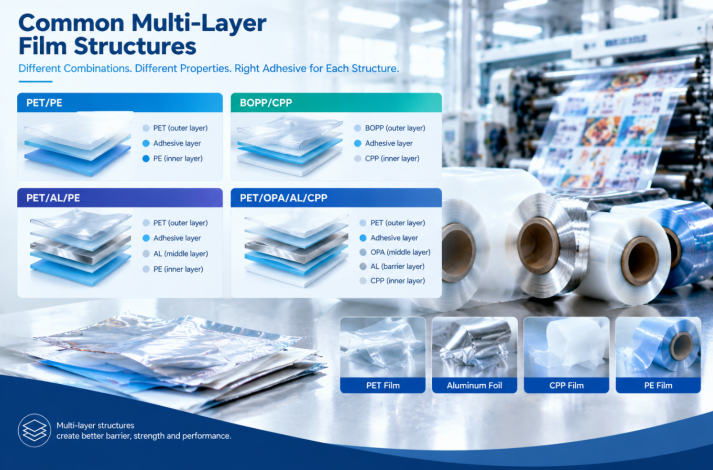
The architecture of a flexible pouch often involves three or more layers: a printable outer layer, a barrier middle layer, and a heat-sealable inner layer. The adhesive must be chemically compatible with the specific polymer at each interface.
| Film Substrate | Surface Character | Surface Treatment Needed | Adhesive Concern |
|---|---|---|---|
| BOPP | Non-polar polyolefin, low surface energy | In-line corona treatment is effectively mandatory | Adhesive must level without disturbing metalized layers |
| PET | Higher natural surface energy | Corona optional depending on finish | Thermal expansion mismatch against aluminium foil |
| CPP | Heat-sealable inner layer | Corona commonly applied | Must not block the heat-seal window |
| Aluminium foil | Metallic, non-absorbent | Surface treatment and anchoring chemistry required | Blocking, telescoping, and delamination on flex |
| Multi-layer laminate | Mixed polymers at each interface | Interface-by-interface matching | One weak interface fails the whole structure |
Surface energy is measured in dyne levels. Because a liquid adhesive can only wet a substrate when its own surface tension sits below the substrate surface energy, an untreated polyolefin film simply beads up instead of spreading. Corona treatment uses a high-voltage electrical discharge to oxidise the surface and lift that energy just before the applicator reaches it, which is why it has to be done in line rather than once during slitting.
4.1 BOPP Film Applications
BOPP (Biaxially Oriented Polypropylene) is incredibly popular due to its excellent moisture barrier, high tensile strength, and low cost. It is the default outer printed layer for snacks, chips, and pasta. However, because it is an inherently non-polar polyolefin, it actively resists chemical bonding.
In-line corona treatment is practically mandatory to raise the surface energy of BOPP immediately before the adhesive application station. When laminating BOPP to metalized CPP (cast polypropylene) for chip bags, manufacturers require an adhesive with exceptional leveling properties to avoid disrupting the ultra-thin aluminum layer. KONSENT engineered a dedicated BOPP laminating glue specifically for this dynamic, providing ultra-low viscosity at application temperature to ensure a flawless, mirror-like finish without optical speckling.
4.2 PET Film Applications
PET (Polyethylene Terephthalate) offers a naturally higher surface energy than BOPP, making it easier to bond. It provides a superior oxygen barrier and can withstand significantly higher temperatures, making it the preferred outer layer for stand-up pouches, retort packaging, and microwaveable foods.
When laminating PET to aluminum foil (PET/AL structures), the adhesive must accommodate the different thermal expansion rates of plastic and metal. Solventless adhesives are highly effective for standard PET structures, but if the final PET pouch is destined for high-temperature sterilization, a high-performance two-component solvent-based system must be deployed to prevent the layers from shearing apart under the stress of the autoclave.
5. Regulatory Compliance and PPWR Recyclability
Film lamination introduces a compliance variable that paperboard converting does not have. In a carton, adhesive is absorbed into a porous fiber network. Between two non-porous films, the adhesive layer is sealed in, so anything left unreacted stays trapped in the laminate instead of being absorbed away. Cure completion therefore becomes a compliance step, not just a strength step.
The first specific risk is Primary Aromatic Amines (PAAs), toxic byproducts that can form when an isocyanate component cures incompletely. Aliphatic polyurethane chemistries avoid PAA formation altogether, so specifying a solventless system built on aliphatic resin is the single most effective way to control this risk. The practical discipline is to demand a cure schedule and a PAA declaration from your supplier, and to confirm the master roll has fully cross-linked before slitting or regrinding.
The second risk is end-of-life. When a laminated film structure is recycled, the adhesive must not gum up shredders or cloud the recycled resin. This is why mono-material film structures are the direction the industry is moving, and it places a new requirement on the laminating adhesive: it must stay compatible with mechanical recycling streams. Detailed regulatory thresholds, migration testing protocols, and PPWR grading criteria all govern these decisions, so ask any supplier which specific limits their grade has been tested against rather than accepting a general claim of compliance. The structural design side of recyclable pouch systems is addressed in adhesive for flexible packaging pouches and films.
6. Quality Control Variables on the Lamination Line
Even the highest quality adhesive will fail if line operators do not control the mechanical and environmental variables during application. The three most critical parameters are nip temperature, web tension, and mixing ratios.
Nip temperature refers to the heated steel roller that presses the two films together. For solventless systems, the nip must be maintained at an exact temperature (often around 40–50°C) to briefly lower the adhesive’s viscosity, ensuring it spreads into microscopic film imperfections before cooling.
Web tension mismatch is the leading cause of “tunneling”—a defect where the laminated film buckles and separates in long, worm-like ridges. BOPP and PE films stretch at different rates under the pulling force of the machine. If the tension is not perfectly balanced between the primary and secondary unwinds, the more stretched film will attempt to shrink back to its original size after exiting the nip, shearing the curing adhesive bond. Finally, exact mix ratios (typically 100:80 or 100:50 for solventless PU) must be maintained by the gear pumps; a deviation of even 2% will leave unreacted monomers in the adhesive layer, ruining the cure and violating food safety migration limits.
7. Conclusion
Successfully manufacturing flexible packaging requires treating the laminating adhesive not as a basic consumable, but as an engineered structural component. The choice between solventless, solvent-based, and water-based systems dictates your operational efficiency, energy costs, and regulatory liability. By rigorously controlling film dyne levels (~38), optimizing coating weights (1.2–2.5 g/m² for solventless), and strictly adhering to cure schedules, manufacturers can eliminate delamination scrap and produce flawless, high-clarity structures.
As the industry shifts toward PPWR-compliant mono-materials, ensuring your adhesive chemistry matches your substrate strategy is more critical than ever. To evaluate the exact coating weights, curing profiles, and food-safety certifications required for your specific BOPP or PET film structures, contact our technical team to request a targeted material consultation and localized factory trial.
FAQ
What causes tunneling in laminated films?
Tunneling is primarily caused by mismatched web tension between the two films during lamination. If one substrate is stretched tighter than the other as they pass through the nip roller, it will attempt to retract during the curing phase, creating shear stress that rips the adhesive bond apart into visible ridges.
Why is corona treatment required for BOPP films?
BOPP has a naturally low surface energy that repels liquids, making chemical bonding impossible. Corona treatment applies a high-voltage electrical discharge to the film surface, oxidizing it and raising the surface energy to a dyne level of approximately 38, which allows the adhesive to properly wet out.
What is the standard coating weight for solventless laminating adhesive?
Standard solventless coating weights range from 1.2 to 2.5 g/m². Because the adhesive is 100% solid and contains no carrier fluids to evaporate, the weight applied at the roller is exactly the dry weight that remains in the finished structure.
How long does solventless adhesive take to cure?
Solventless polyurethane adhesives typically require 24 to 48 hours stored in a heated curing room at 35–45°C. Attempting to slit the master rolls or form pouches before this cross-linking process completes will result in structural failure.
What is PAA and why is it regulated in packaging?
PAA stands for Primary Aromatic Amines, which are potentially harmful chemical byproducts that can form if certain polyurethane adhesives do not cure properly. Because they pose health risks, food contact regulations set strict migration limits into food simulants. The practical step for a film converter is to specify an aliphatic polyurethane system and require a PAA declaration from the adhesive supplier before approving the structure.
