
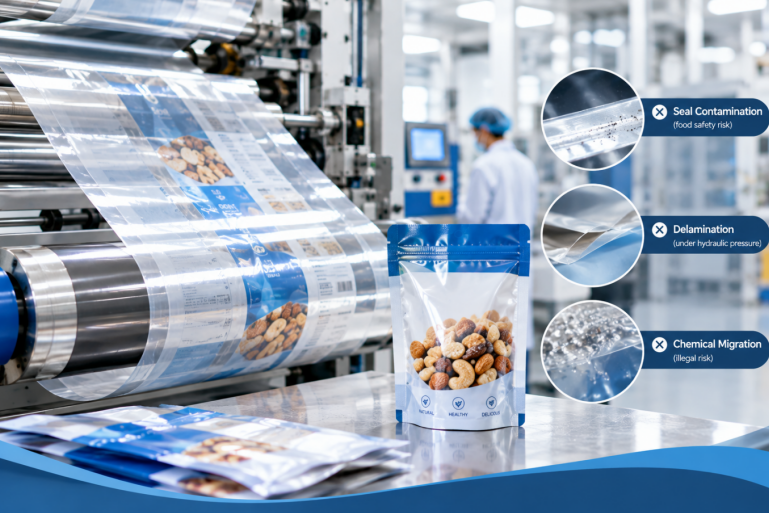
Manufacturing defect-free stand-up pouches, sachets, and barrier flow-wraps requires an adhesive system capable of balancing high shear strength, optical transparency, and strict food contact compliance. When converting multi-ply films, choosing an incorrect adhesive formulation causes seal contamination, delamination under hydraulic pressure, or illegal chemical migration into packaged goods. Within the broader scope of our comprehensive packaging glue guide for adhesive families and selection, selecting the proper adhesive for flexible packaging requires harmonizing two-component solventless or solvent-based chemistries with substrate dynamics across polyethylene, polypropylene, and aluminum barrier webs.

Table of Contents
- Multi-Layer Pouch Architectures and Substrate Combinations
- Solventless vs. Solvent-Based Adhesive for Flexible Packaging
- Technical Performance Matrix for Common Pouch Structures
- Preventing Critical Pouch Failures on Converting Lines
- Food Contact Safety, Migration Limits, and Recyclability
- Machine Processing Parameters and Application Best Practices
- Conclusion
1. Multi-Layer Pouch Architectures and Substrate Combinations
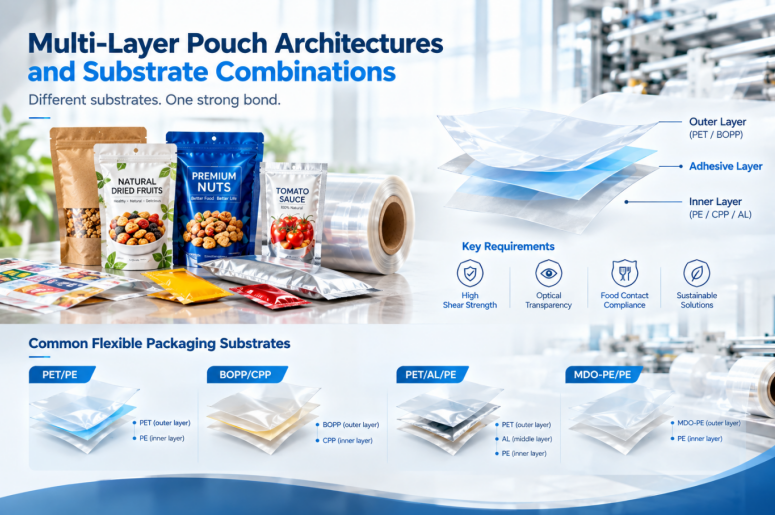
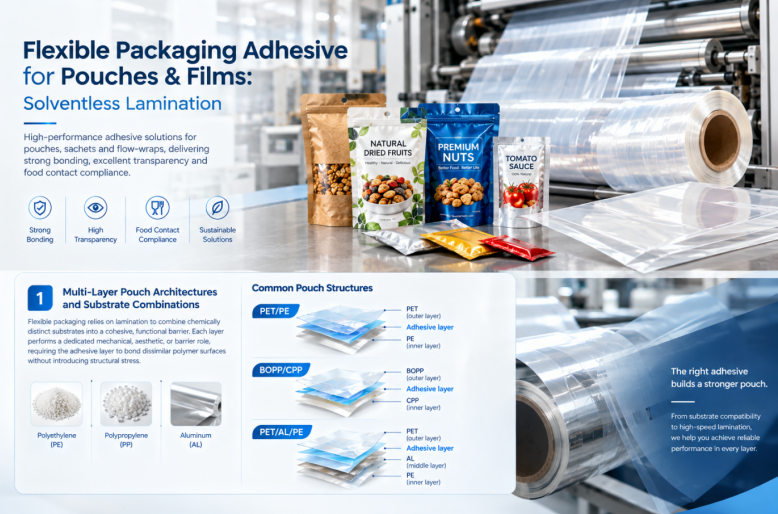
Flexible packaging relies on lamination to combine chemically distinct substrates into a cohesive, functional barrier. Each layer performs a dedicated mechanical, aesthetic, or barrier role, requiring the adhesive layer to bond dissimilar polymer surfaces without introducing structural stress.
1.1 Two-Ply Film-to-Film Laminates (PET/PE and BOPP/CPP)
Two-ply constructions form the backbone of dry food, confectionery, and household detergent packaging. In a standard PET/PE pouch, the outer Polyethylene Terephthalate (PET) layer delivers dimensional stability, high-definition reverse printability, and thermal resistance during heat-sealing. The inner Linear Low-Density Polyethylene (LLDPE) web serves as the hermetic, heat-sealable layer.
Executing high-speed film to film lamination on these webs requires rapid wet-out across low-polarity surfaces. Because these films present low natural surface tension, maintaining precise corona treatment and understanding the underlying laminating adhesive for BOPP and PET films is necessary to maintain wetting tension above 38 dynes/cm. BOPP/CPP laminates, common in crisp packaging and biscuits, require an adhesive that retains flexibility at low temperatures while withstanding the migration of fatty food oils.
1.2 Three-Ply and Four-Ply Foil Barrier Webs (PET/AL/PE)
High-barrier packaging for roasted coffee, powdered nutritional formulas, and pharmaceuticals demands total exclusion of oxygen, light, and water vapor. These laminates incorporate an intermediate layer of aluminum foil, typically 6 to 9 microns thick.
Aluminum foil possesses zero natural elasticity and oxidizes instantly upon atmospheric exposure. A dedicated aluminum foil laminating adhesive must deliver high initial tack to prevent micro-tunneling while providing chemical resistance against volatile aromas, organic acids, and essential oils. In four-ply retrievable medical or retort structures (PET/OPA/AL/CPP), the adhesive must withstand severe mechanical elongation during pouch gusseting without shearing away from the aluminum oxide interface.
1.3 Sustainable Mono-Material Structures (MDO-PE/PE and BOPE/PE)
Global regulatory shifts toward the circular economy have driven rapid adoption of mono-material polyolefin laminates designed for existing mechanical recycling streams. Replacing PET with Machine Direction Oriented Polyethylene (MDO-PE) or Biaxially Oriented Polyethylene (BOPE) presents severe processing challenges.
Oriented polyethylene films have lower thermal resistance than polyester, stretching or warping if exposed to excessive nip temperatures or unvented web tensions. A specialized solventless laminating adhesive for pouches engineered for mono-PE structures must cure effectively at lower nip temperatures, maintaining high bond strength without causing film deformation or web necking during rewind.
2. Solventless vs. Solvent-Based Adhesive for Flexible Packaging
Selecting the carrier vehicle and curing mechanism dictates both operational factory economics and end-use pouch resilience. Converting operations must match chemical cross-linking kinetics to the mechanical demands of the pouch format.
2.1 Two-Component Solventless Polyurethane Chemistry
Two-component (2K) solventless polyurethane adhesives consist of an isocyanate-terminated prepolymer (NCO) and a polyol curative (OH). Operating at 100% active solids, this chemistry eliminates carrier solvents, drying ovens, and VOC recovery infrastructure.
Solventless lamination delivers dramatic operational advantages: lamination speeds exceeding 350 to 450 m/min, reduced energy consumption, and zero risk of retained solvent off-flavors. However, solventless systems provide negligible green strength directly off the rewind roll. They depend on stoichiometric addition reactions over a 24- to 72-hour curing cycle to develop ultimate shear and chemical resistance, requiring disciplined warehouse management and heated curing cells.
2.2 Solvent-Based Polyurethane Systems for Demanding Fills
Solvent-based polyurethanes dissolve high-molecular-weight polymers in ethyl acetate. The solvent carrier is fully evaporated across multi-zone drying tunnels before the coated web marries the secondary substrate in a heated steel nip.
Despite environmental and operating cost burdens, solvent-based adhesives remain irreplaceable for aggressive end-use conditions. When packaging high-acid tomato pastes, alcohol-based wipes, aggressive cosmetics, or pouches undergoing thermal retort sterilization (121°C for 30–60 minutes), solvent-based adhesives offer superior cross-linking density. This structural density prevents volatile organic contents from swelling or plasticizing the adhesive matrix over long shelf lives.
3. Technical Performance Matrix for Common Pouch Structures
Optimizing coat weights and bonding profiles requires understanding the mechanical stresses each laminate structure experiences during pouch formation, automated filling, and transport.
| Pouch Structure | Recommended Adhesive Chemistry | Target Dry Coat Weight | Typical Cured Peel Strength | Primary Risk Factor |
|---|---|---|---|---|
| PET / LLDPE (General Goods) | Standard 2K Solventless PU | 1.3 – 1.8 g/m² | > 3.5 N / 15 mm | Additive migration to seal interface |
| PET / AL / LLDPE (Coffee & Barrier) | High-Performance Solventless PU | 1.8 – 2.5 g/m² | > 4.5 N / 15 mm | Foil corrosion and flex cracking |
| BOPP / Metalized CPP (Snacks) | Ultra-Low Viscosity Solventless PU | 1.1 – 1.5 g/m² | > 2.0 N / 15 mm (Metal Tear) | Aluminum deposition stripping |
| MDO-PE / LLDPE (Recyclable Mono-PE) | Low-Temperature Fast-Cure PU | 1.2 – 1.6 g/m² | > 3.0 N / 15 mm | Thermal elongation and web curl |
| PET / OPA / AL / CPP (Retort Pouch) | High-Performance Solvent-Based PU | 3.5 – 4.5 g/m² | > 5.5 N / 15 mm | Interfacial blistering during sterilization |
Achieving these performance metrics requires utilizing high-solid packaging printing adhesives for converters formulated with specific silane adhesion promoters, which chemically anchor organic polymers to inorganic aluminum oxide barrier surfaces.
4. Preventing Critical Pouch Failures on Converting Lines
Pouch converting exposes laminates to severe physical stress, including folding, multi-axis creasing, ultrasonic sealing, and drop impacts. Identifying root-cause failure modes prevents costly batch rejections and consumer-level leaks.
4.1 Interfacial Delamination and Tunneling
Interfacial delamination occurs when external shear stresses exceed the adhesive layer’s cohesive or adhesive strength. Tunneling appears as parallel, wave-like detachments where the outer film lifts away from the barrier or sealant layer across the web.
This defect typically stems from web tension imbalances during duplex lamination. If the elastic elongation of the sealant film (PE) exceeds that of the rigid outer film (PET) at the nip, the PE film contracts elastically after rewind. This elastic contraction shears the uncross-linked adhesive, creating hollow tunnels. Maintaining load-cell tension control within ± 2% and confirming substrate wetting tension above 38 dynes/cm prevents elastic relaxation defects.
4.2 Seal Interface Contamination and Burst Failures
A catastrophic yet frequently misdiagnosed failure occurs when stand-up pouches burst open at the hermetic seal during drop testing or transit. This problem usually traces back not to the pouch machine’s heat-seal jaws, but to chemical migration originating in the adhesive layer.
If a two-component adhesive is mixed off-ratio, unreacted monomeric isocyanate or low-molecular-weight polyol components remain unbound. Over time, these unbound molecules migrate through the amorphous regions of the thin polyethylene sealant film, depositing a microscopic liquid boundary layer onto the heat-seal surface. During heat sealing, this chemical layer acts as a lubricant, preventing polyethylene chains from fusing and cutting seal strength by up to 60%.
4.3 Odor Generation and Organoleptic Degradation
Food and beverage brand owners enforce stringent organoleptic standards. Packaging must not impart foreign odors or off-tastes to sensitive products like infant formula, water, or confectionery.
In solvent-based converting, off-odors occur when inadequate oven airflow or excessive line speeds leave residual ethyl acetate above 5 mg/m². In solventless operations, odor issues typically originate from moisture-scavenging side reactions. If unreacted aromatic isocyanate reacts with atmospheric moisture inside curing rooms, it forms aromatic diamines and volatile aldehydes, imparting an undesirable medicinal or plastic aroma to the packaged food.
4.4 Primary Aromatic Amine (PAA) Migration
Flexible packaging converters utilizing aromatic polyurethane adhesives (typically based on MDI or TDI isocyanates) face rigorous regulatory scrutiny regarding Primary Aromatic Amines (PAAs). If unreacted monomeric isocyanates migrate through the food contact layer before polymerization finishes, they hydrolyze into toxic PAAs upon contact with aqueous foods.
Laminated films must never enter slitting or pouch-making operations until full cross-linking has occurred and laboratory migration testing confirms PAA levels remain undetectable.
| Failure Mode | What It Looks Like | Root Cause | Corrective Action |
|---|---|---|---|
| Interfacial delamination | Film separates cleanly at the adhesive line | Insufficient wet-out or coat weight below spec | Raise coat weight into the qualified window; check surface energy |
| Tunneling | A void channel runs through the adhesive layer | Mixing ratio off, or entrained moisture reacting with isocyanate | Verify metering accuracy and dry the substrate before application |
| Seal interface contamination | Weak seal strength across the fin seal | Adhesive drawn into the seal area, or slip agents migrating | Keep adhesive out of the seal zone; check peelable film and surface contamination |
| Burst failure | Pouch splits under filling pressure | Bond too weak for the fill, or stress concentrates at a fold | Move to a higher-peel chemistry and add a reinforcing laminate layer |
| Odor generation | Off-odour in the finished pack | Incomplete reaction or solvent residue | Confirm full cure before converting; review mixing ratio |
| PAA migration | Exceeds the migration limit in testing | Aromatic isocyanate content too high | Specify low-monomer aliphatic chemistry and request the test report |
Tunneling is the failure most often blamed on the film supplier when it is actually a metering problem: the two components arrive at the mix head in the wrong ratio, and the unreacted isocyanate reacts with whatever moisture is present, leaving a channel instead of a bond. Seal interface contamination is the mirror image, where too much adhesive is not the issue but exactly where it landed is.
5. Food Contact Safety, Migration Limits, and Recyclability
Compliance in flexible packaging is governed by precise quantitative migration limits rather than generic material approvals. Converting engineers must maintain documented compliance across key international jurisdictions.
5.1 FDA 21 CFR 175.105 and Functional Barriers
Under US FDA regulations, flexible packaging glue used in multi-layer laminates falls under Title 21 CFR 175.105 (Adhesives). This regulation mandates that adhesives either be separated from food by an effective functional barrier or applied in quantities that prevent adulteration of the food product.
When utilizing thin, non-barrier polyethylene sealant webs (less than 25 microns), converters must conduct migration testing or verify through extraction studies that no unreacted formulation components pass through the sealant layer under maximum operational temperatures and intended shelf-life conditions.
5.2 EU 10/2011 and Specific Migration Limits (SML)
European Union Regulation (EU) No 10/2011 establishes stringent rules for plastic materials intended for food contact. It sets an Overall Migration Limit (OML) of 10 mg/dm² (or 60 mg/kg of food) alongside individual Specific Migration Limits (SML) for listed chemical substances.
For Primary Aromatic Amines, the European standard requires that migration into acidic, aqueous, or fatty food simulants remain below the analytical detection limit of 0.01 mg/kg. To guarantee compliance, converting plants must implement standardized photometric or HPLC-MS testing protocols on cured laminate samples before releasing master rolls to food brand customers.
5.3 PPWR Circularity and Mono-Material Recycling
The European Packaging and Packaging Waste Regulation (PPWR) mandates that all packaging placed on the EU market be designed for recyclability by 2030, with strict performance grades scaling toward 2040. Traditional multi-material structures like PET/PE or PET/AL/PE are designated non-recyclable in standard mechanical recycling streams.
Developing recyclable flexible packaging requires using mono-material polyolefin systems (all-PE or all-PP). In these structures, the adhesive must represent less than 5% of the total laminate weight and remain chemically compatible with polyolefin remelting. Modern circular adhesive formulations are engineered to avoid yellowing, gel formation, or polymer chain scission during the mechanical extrusion and pelletization of post-industrial packaging scrap.
The adhesive is only one variable in this calculation, and the film side of the structure carries its own compliance weight. How a polyurethane laminating adhesive behaves on BOPP and PET film, how its cure schedule interacts with trapped unreacted monomers, and how coating weight and surface energy affect a finished laminate are covered in detail in laminating adhesive for BOPP and PET films.
6. Machine Processing Parameters and Application Best Practices
Consistent bond quality in solventless lamination depends heavily on mechanical precision at the application unit. Deviations in dosing or roll temperature directly compromise the cured polymer network.
6.1 Mixing Ratio and Metering Accuracy
Two-component solventless adhesives require strict stoichiometric mixing, generally within a tolerance of ± 1.0% to 1.5% of the designated ratio. Modern continuous mix-metering units utilize digital mass-flow gear pumps to monitor chemical delivery.
An excess of isocyanate component prolongs the curing cycle and increases the duration of PAA migration risks. Conversely, an excess of polyol results in incomplete cross-linking, causing permanent tackiness, low shear resistance, and severe heat-seal contamination. Operators must conduct daily manual gravimetric calibration checks prior to production runs.
6.2 Application Roller Temperature and Viscosity Control
Solventless adhesives exhibit high room-temperature viscosities (often between 1,000 and 3,000 mPa·s). To achieve smooth transfer without aerodynamic misting at line speeds over 300 m/min, the adhesive must be heated across a multi-roll metering stack:
- Dosing Roll: Maintained at 40°C to 45°C to reduce bulk viscosity to approximately 400–600 mPa·s.
- Transfer Roll: Heated to 42°C to 48°C to establish an ultra-thin, smooth chemical film without ribbing.
- Coating / Nip Roll: Set between 45°C and 55°C, ensuring complete wetting onto the primary film surface before entering the lamination nip under 4 to 6 bar of pneumatic pressure.
6.3 Post-Lamination Curing Protocols
Unlike solvent-based systems that exhibit functional handling strength immediately upon exiting drying tunnels, solventless rolls exit the rewinder in a semi-liquid state. Slitting or pouch-making must not proceed immediately.
Master reels must be transferred to dedicated, temperature-controlled curing chambers maintained at 35°C to 45°C. Relative humidity should be monitored between 40% and 60% to support proper secondary cross-linking reactions. Standard structures require 24 to 48 hours of chamber dwell time, while high-barrier aluminum foil structures or chemical-resistant grades require 72 hours to achieve full chemical and thermal resistance.
7. Conclusion
Successfully executing pouch and film lamination requires treating the laminating adhesive as an engineered structural layer rather than an auxiliary consumable. Matching adhesive chemistry to substrate mechanics—whether running high-speed solventless film to film lamination on PET/PE, deploying chemical-resistant systems on aluminum barrier webs, or optimizing low-temperature lines for recyclable mono-PE—directly governs pouch integrity and production profitability. By maintaining precise stoichiometric mixing, monitoring application roll temperatures, and enforcing curing protocols, converters eliminate delamination defects, prevent heat-seal failures, and verify food-contact compliance.
To evaluate bond strengths on challenging films, optimize coating parameters, or request certified formulation samples for your converting operations, contact our technical team to schedule customized substrate testing and on-site line trials.
FAQ
What causes stand-up pouches to burst open at the seal during drop tests?
Seal burst failure is frequently caused by adhesive migration. When two-component solventless adhesives are mixed off-ratio, unreacted monomeric components migrate through the thin polyethylene sealant layer to the seal interface. During heat sealing, these migrated chemicals act as contaminants that prevent polymer chains from fusing properly, significantly weakening the heat seal.
Why is solventless lamination preferred over solvent-based systems for standard pouches?
Solventless lamination operates at 100% active solids, eliminating drying ovens, VOC emissions, and solvent recovery systems. This significantly lowers operational energy costs, enables higher production line speeds up to 450 m/min, and eliminates the risk of retained solvent odors in food packaging.
What minimum surface tension is required for film to film lamination?
Substrate films such as BOPP, PET, and PE must maintain a minimum surface energy of 38 dynes/cm. If the surface energy drops below this threshold due to additive blooming or inadequate corona treatment, the adhesive cannot wet out uniformly, leading to optical mottling and delamination.
How long must solventless laminated rolls cure before slitting or pouch converting?
Standard film-to-film structures typically require 24 to 48 hours of curing in a temperature-controlled room held at 35°C to 45°C. Complex structures containing aluminum foil or laminates intended for aggressive fills generally require 72 hours to ensure complete isocyanate conversion and eliminate PAA migration risks.
What is the regulatory limit for Primary Aromatic Amine migration in the European Union?
Under Regulation (EU) No 10/2011, Primary Aromatic Amines (PAAs) in food packaging laminates must not migrate into food simulants in detectable quantities. The maximum allowable threshold is strictly below the analytical detection limit of 0.01 mg/kg.
Can standard solventless adhesives be used for mono-material PE pouches?
Standard solventless adhesives often require application temperatures or web tensions that cause oriented polyethylene (MDO-PE) films to stretch or curl. Recyclable mono-material PE pouches require specialized low-temperature, fast-curing formulations that bond securely without causing thermal distortion or interfering with downstream mechanical recycling streams.
What is the typical dry coat weight for solventless pouch lamination?
Typical dry coat weights for solventless pouch lamination range from 1.2 to 1.8 g/m² for standard film-to-film structures, and 1.8 to 2.5 g/m² for structures incorporating aluminum foil or heavy ink coverage. Because solventless adhesives contain 100% solids, the applied wet weight equals the final dry weight.
