Choosing the right polymer emulsion supplier requires evaluating formulation compatibility, batch-to-batch consistency, and technical support capabilities, rather than relying solely on raw material cost. For industrial adhesive manufacturers, selecting an incompatible emulsion can lead to viscosity drift, prolonged pressing times, and catastrophic bonding failures in end-user applications. This guide provides technical decision-makers with a comprehensive framework for evaluating polymer systems, interpreting critical specifications, mitigating formulation risks, and selecting a reliable partner for scalable mass production.
Table of Contents
- Why Supplier Selection Goes Beyond Unit Price in Adhesive Manufacturing
- Evaluating Polymer Systems for Specific Adhesive Formulations
- Critical Technical Specifications to Verify Before Formulation
- Assessing Formulation Compatibility and Manufacturing Impact
- Real-World Application Scenarios and Problem Solving
- Scalability and Batch Consistency for Mass Production
- A Decision-Making Framework for Evaluating Emulsion Suppliers
- Conclusion
1. Why Supplier Selection Goes Beyond Unit Price in Adhesive Manufacturing
A reliable polymer emulsion supplier provides stable material specifications, formulation troubleshooting, and scalable capacity to prevent costly adhesive failures in continuous industrial production.
In the highly competitive adhesive manufacturing sector, procurement teams often face pressure to source the lowest-cost raw materials. However, treating polymer emulsions as simple commodities is a critical mistake. The base emulsion typically dictates over 80% of an adhesive’s final performance, governing curing speed, initial tack, environmental resistance, and substrate adaptability.
When a supplier offers a low unit price but lacks batch-to-batch consistency or technical support, the hidden costs manifest rapidly on the production floor. Fluctuating solid content can force formulators to constantly adjust thickeners, while unstable particle sizes can lead to premature coagulation during storage. An experienced supplier acts as a technical partner, offering not just a product, but a tailored chemical foundation that matches the exact processing conditions and application requirements of the adhesive manufacturer.
2. Evaluating Polymer Systems for Specific Adhesive Formulations
Selecting the correct base polymer—such as PVAc for porous woods or VAE for difficult plastic substrates—is the foundational step in developing high-performance industrial adhesives.
Different polymer systems exhibit distinct molecular structures, polarities, and film-forming characteristics. A supplier’s value is directly tied to the breadth of their portfolio, allowing manufacturers to choose the exact chemistry required for their market segment. KONSENT’s comprehensive portfolio of polymer emulsions covers a wide spectrum, including Polyvinyl Acetate (PVAc), Vinyl Acetate-Ethylene (VAE), Styrene-Acrylic, Acrylic, Vinyl Versatate, and Polyurethane Dispersions (PUD).
PVAc is highly crystalline and provides excellent tensile strength on porous substrates like wood and paper, making it the backbone of woodworking adhesives. However, its rigidity can be a drawback when bonding flexible materials. In contrast, VAE incorporates ethylene segments into the polymer chain, acting as an internal plasticizer. This grants VAE permanent flexibility, excellent low-temperature performance, and aggressive adhesion to non-porous surfaces like PVC films and treated plastics.
Acrylic emulsions are engineered for exceptional UV stability, weather resistance, and clear film formation, dominating the pressure-sensitive adhesive (PSA) and exterior coating markets. Selecting a supplier with a diverse portfolio ensures that you are not forced to compromise your formulation to fit a limited product catalog.
Comparison of Industrial Polymer Emulsion Systems
| Evaluation Factor | PVAc (Polyvinyl Acetate) | VAE (Vinyl Acetate-Ethylene) | Acrylic Emulsions | PUD (Polyurethane Dispersion) |
| Primary Strength | High ultimate bond strength, excellent wood penetration, fast setting. | High flexibility, broad substrate adhesion, internally plasticized. | Excellent UV/weather resistance, high optical clarity. | Premium toughness, extreme water/heat resistance, high elasticity. |
| Limitations | Rigid film, poor adhesion to non-porous plastics, lower water resistance (unless crosslinked). | Lower cohesive strength than pure PVAc, susceptible to creep at high temps. | Generally higher cost, may require complex rheology modification. | Highest cost, pH sensitivity, requires precise formulation control. |
| Best Applications | Woodworking glue, paperboard assembly, craft DIY adhesives. | Film lamination, bookbinding, difficult packaging substrates. | Pressure-sensitive adhesives, construction mastics, exterior labels. | Automotive interiors, technical textiles, membrane press adhesives. |
| Decision Rule | Recommended for standard porous substrates where rigidity is acceptable. | Recommended when bonding low-surface-energy plastics or requiring flexibility. | Recommended for long-term outdoor exposure or transparent films. | Recommended for premium applications demanding extreme durability. |
3. Critical Technical Specifications to Verify Before Formulation
Adhesive manufacturers must strictly evaluate solid content, viscosity, and particle-size distribution, as these parameters directly dictate the drying speed, penetration, and final bond strength of the adhesive.
Technical specifications are not just numbers on a Technical Data Sheet (TDS); they define how the emulsion will behave under high-shear mixing, pumping, and end-user application.
Solid Content: This dictates the amount of active polymer remaining after the water evaporates. Higher solid content generally translates to faster drying times, lower shrinkage, and higher initial tack. However, excessively high solids can compromise shelf life and increase raw material costs.
Viscosity and Rheology: Viscosity determines the flow characteristics of the adhesive. Low-viscosity emulsions penetrate deeply into porous substrates (ideal for structural wood bonds), while high-viscosity emulsions offer excellent gap-filling properties and prevent sagging on vertical surfaces.
By assessing technical data for specific grades of polymer emulsions before trial runs, engineers can predict formulation behavior. For example:
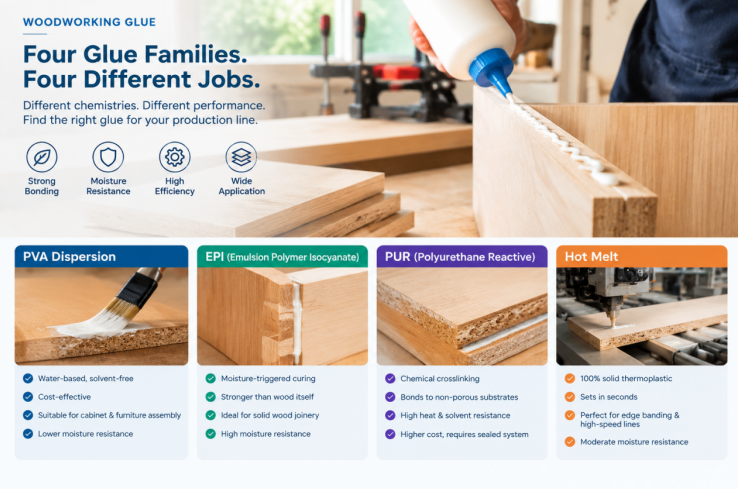
- KONSENT HS-105: Features a solid content of 46.0–50.0% and a remarkably low viscosity of 1,000–2,500 CPS. This grade is specifically positioned for Emulsion Polymer Isocyanate (EPI) adhesive applications. The low viscosity allows for deep wood penetration and easy mixing with isocyanate hardeners, while the engineered polymer backbone emphasizes film toughness, high reactivity, and superior water resistance (critical for D4 wood adhesives).
- KONSENT HS-400: Features a higher solid content of 50.0–54.0% and a much higher viscosity of 25,000–35,000 CPS. This rheology profile is deliberately positioned for water-based yellow glues, furniture assembly adhesives, and pressing-plate applications where immediate wet tack and gap-filling capabilities are required to hold components together before curing.
4. Assessing Formulation Compatibility and Manufacturing Impact
Before mass production, polymer emulsions must be rigorously tested for compatibility with thickeners, crosslinkers, and fillers to prevent coagulation, phase separation, or viscosity instability during storage.
An industrial adhesive is a complex chemical system. The base polymer emulsion must coexist peacefully with a variety of functional additives. A common mistake made by procurement teams is purchasing a generic emulsion based on price, only to discover that it undergoes “viscosity shock” or phase separation when compounded with the company’s proprietary additive package.
When evaluating a supplier, verify the emulsion’s compatibility with:
- Thickeners: Polyurethane associative thickeners (HEUR) or cellulosic thickeners (HEC) behave differently depending on the emulsion’s surfactant system.
- Fillers: Calcium carbonate or clay can strip surfactants from the polymer particles, causing agglomeration. The emulsion must have sufficient mechanical and chemical stability to withstand high filler loading.
- Crosslinkers: For EPI or crosslinking PVA applications, the emulsion must contain reactive sites (like hydroxyl groups) to bond with isocyanates or silanes, without premature gelation.
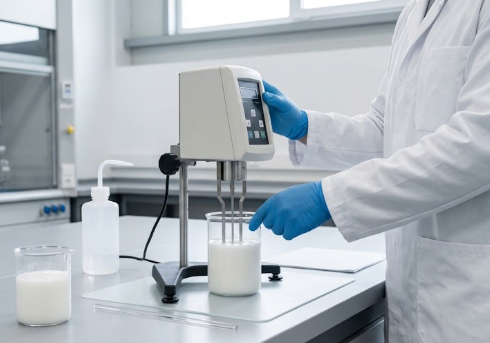
A reliable supplier provides explicit application recommendations and compatibility guidelines. Small-scale lab trials, followed by pilot plant runs, are mandatory before scaling to mass production to evaluate how the emulsion handles high-shear mixing and long-term storage in the final formulation.
5. Real-World Application Scenarios and Problem Solving
Customized emulsion formulations solve specific production bottlenecks, such as optimizing PVAc for EPI adhesives to reduce pressing times or improving humidity resistance in furniture assembly.
The true test of a polymer emulsion supplier is their ability to bridge the gap between laboratory specifications and factory-floor realities. KONSENT’s engineering approach focuses on solving distinct industrial challenges rather than supplying one-size-fits-all liquids.
Scenario 1: EPI Wood Adhesive Instability
- The Challenge: A furniture manufacturer experienced inconsistent bonding strength, excessively long pressing times in their hot press lines, and unstable adhesive viscosity that led to application errors.
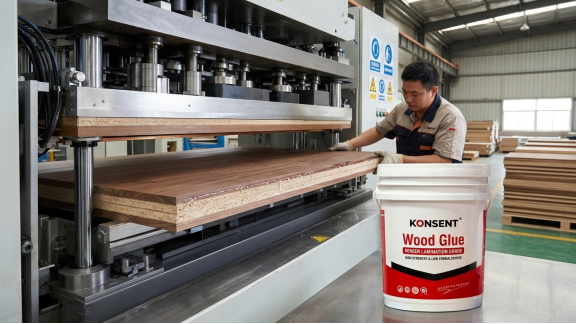
- The Solution: KONSENT engineered a specially selected PVAc emulsion (similar to the HS-105 profile) with optimized solid content and a highly controlled particle-size distribution.
- The Result: The tight particle-size control improved the emulsion’s reactivity with the isocyanate crosslinker, leading to significantly higher bond strength, vastly improved pressing efficiency, and long-term viscosity stability during storage.
Scenario 2: Furniture Assembly Adhesive Failure in High Humidity
- The Challenge: An assembly plant faced slow curing speeds and critical adhesive failures under high-humidity conditions, leading to joint separation during shipping.
- The Solution: KONSENT supplied a custom-optimized PVAc emulsion targeting faster water release and crosslinking density.
- The Result: The formulation achieved faster curing, exceptional initial tack, secure final adhesion, and maintained structural integrity in humid environments, all while meeting stringent low-VOC emission standards required for indoor furniture.
Scenario 3: Paperboard White Glue and Carton Cracking
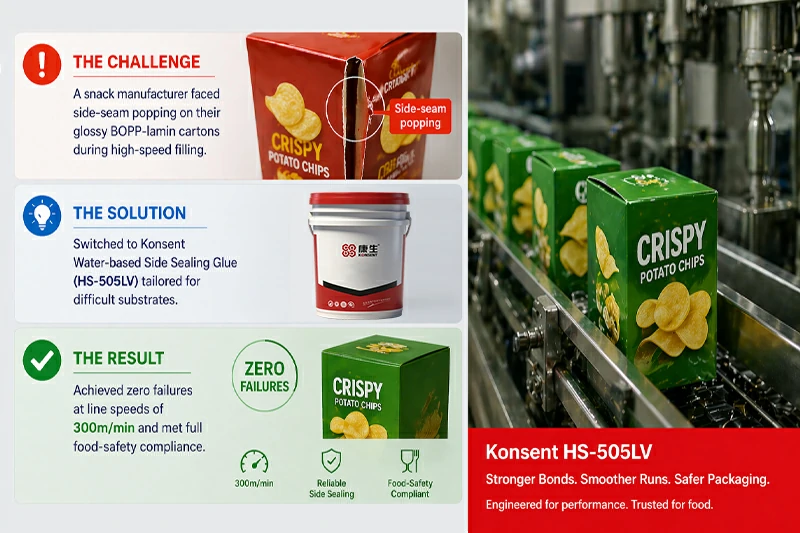
- The Challenge: A packaging manufacturer struggled with insufficient bonding strength on high-tension paperboard folds, resulting in cartons popping open (cracking) during transit, compounded by line-slowing cure rates.
- The Solution: KONSENT provided a tailored PVAc emulsion engineered for high wet tack and rapid film formation.
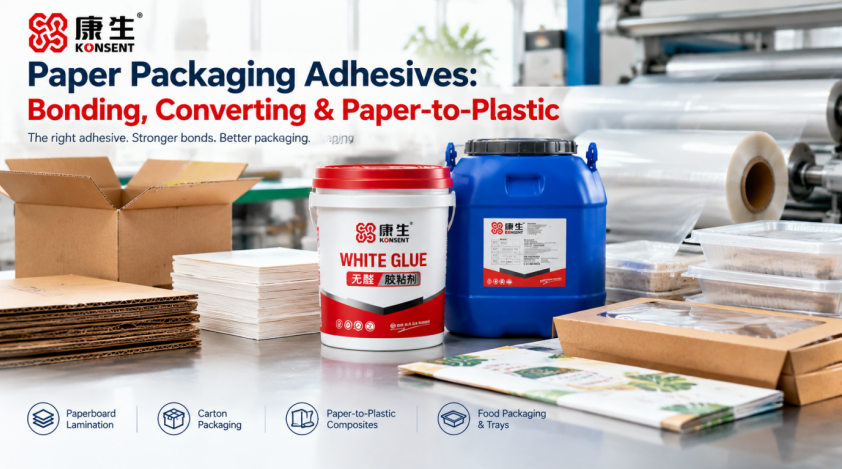
- The Result: The customized glue eliminated carton cracking by ensuring deep fiber tear upon testing, drastically improved curing speed on the folding gluer machine, and supported sustainable low-VOC requirements.
6. Scalability and Batch Consistency for Mass Production
A qualified supplier must demonstrate robust automated quality control and scalable manufacturing capacity to ensure stable viscosity, solids, and performance across every bulk delivery.
Successfully validating a sample in the laboratory is only the first step; maintaining that exact performance over hundreds of metric tons is where many suppliers fail. For industrial compounders, batch inconsistency is catastrophic. A shift in pH or surfactant concentration from the supplier can ruin an entire batch of formulated adhesive, leading to extensive downtime and rejected material.
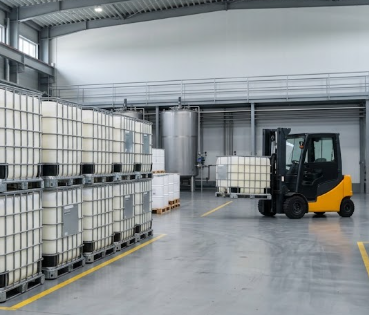
Therefore, procurement strategies must assess a supplier’s manufacturing infrastructure. By partnering with a manufacturer that supplies high-quality polymer emulsions in bulk, buyers mitigate supply chain risks. For example, KONSENT operates 4 global factories with an annual production capacity of 100,000 tons. This scale proves the ability to support adhesive manufacturers through the entire product lifecycle: from initial 1-liter sample testing, through pilot formulation validation, all the way to continuous, multi-ton bulk supply via IBC totes or bulk tankers. Stringent quality control systems ensure that the hundredth batch performs exactly like the first validated sample.
7. A Decision-Making Framework for Evaluating Emulsion Suppliers
Procurement teams should evaluate suppliers based on their polymer portfolio breadth, customizable technical support, production capacity, and ability to ensure long-term batch consistency.
To minimize risks and optimize adhesive performance, use the following evaluation framework before signing a supply contract:
- Portfolio Breadth: Can the supplier offer alternative chemistries (VAE vs. PVAc) if your substrate requirements change?
- Verifiable Technical Data: Do they provide comprehensive TDS documents detailing solid content, viscosity profiles (e.g., Brookfield CPS), pH, MFFT (Minimum Film Forming Temperature), and Tg (Glass Transition Temperature)?
- Formulation Technical Support: Will their engineers assist in troubleshooting compatibility issues with your existing thickeners and resins?
- Customization Capability: Are they willing to tweak particle size or viscosity for your specific pressing line, or are you forced to buy an off-the-shelf product?
- Scalability: Do they have the audited manufacturing capacity (e.g., 100,000+ tons/year) to guarantee uninterrupted bulk supply during peak production seasons?
8. Conclusion
Selecting a polymer emulsion supplier is a strategic engineering decision, not merely a procurement transaction. The polymer backbone dictates the success or failure of the final adhesive in the field. By prioritizing suppliers who offer a diverse chemical portfolio, rigorous batch-to-batch consistency, deep formulation expertise, and the scalable capacity to move from lab samples to bulk production, adhesive manufacturers can secure their supply chain and elevate their product quality. True value is found in a supplier’s ability to solve real-world bonding challenges and adapt their emulsions to your specific manufacturing realities.
Ready to optimize your adhesive formulations?
Whether you need to resolve viscosity issues, improve curing speeds, or scale up mass production with reliable bulk supply, our engineering team is ready to assist with sample testing and customized solutions. Discuss your technical requirements with our experts today.
FAQs
1. Why does my adhesive viscosity fluctuate between different emulsion batches?
Viscosity drift is often caused by the supplier’s inability to maintain a tight particle-size distribution or consistent surfactant levels during the emulsion polymerization process. It can also result from poor compatibility between a generic emulsion and your specific thickeners. Partnering with a supplier that enforces strict batch-to-batch quality control eliminates this issue.
2. How do I choose between PVAc and VAE emulsions for my adhesive?
Use PVAc when bonding porous substrates like wood or paper where high rigidity, fast setting, and strong tensile strength are required. Switch to VAE when your application demands flexibility, low-temperature performance, or adhesion to low-surface-energy materials like PVC films and plastics.
3. What is the impact of solid content on adhesive performance?
Higher solid content generally accelerates drying time, increases initial wet tack, and reduces the risk of substrate warping because less water is introduced into the joint. However, extremely high solids can increase formulation costs and negatively impact the shelf life and flowability of the adhesive.
4. Can I switch polymer emulsion suppliers without changing my formulation?
Rarely. Even if two emulsions share identical solid content and viscosity specifications on paper, differences in surfactant systems, particle morphologies, and residual monomers can cause severe compatibility issues with your existing additives. Always conduct thorough lab compatibility testing and pilot runs before replacing a base emulsion.
5. Why is particle size important in water-based adhesive emulsions?
Particle size and distribution govern the emulsion’s rheology, stability, and penetration capabilities. Finer particles typically offer better penetration into dense woods (ideal for EPI adhesives) and higher film gloss, while larger particles can provide better mechanical stability and gap-filling properties.