Sourcing woodworking adhesive from a Chinese factory can cut your glue cost by 30–50% compared with buying through a local distributor. It can also burn a production season if you pick the wrong supplier: a trader reselling someone else’s drums, glue that passes the lab sample but fails on your line, or a shipment that sits in port because nobody checked the liquid-cargo paperwork. The difference between the two outcomes is rarely luck — it is the checklist you run before wiring the deposit.
KONSENT exports water-based woodworking adhesives to furniture factories worldwide, and this guide distills the seven checks our best customers run on any new supplier — including on us. Copy it into your sourcing file.
Table of Contents
- Check 1: Verify the Supplier Is a Factory, Not a Trader
- Check 2: Match the Product Range to Your Processes
- Check 3: Demand Test Reports Before You Ask for Samples
- Check 4: Run a Bonded-Panel Trial on Your Own Line
- Check 5: Confirm OEM and Packaging Options in Writing
- Check 6: Nail Down MOQ, Lead Time and Liquid Shipping
- Check 7: Lock Batch Consistency and After-Sales Support
- Red Flag Summary

1. Check 1: Verify the Supplier Is a Factory, Not a Trader
Most “woodworking adhesive suppliers” you find online are trading companies. Traders are not always bad — some offer useful consolidation — but they add a margin, slow down technical answers, and disappear exactly when a batch goes wrong and you need the people who mixed it.
Three quick verifications work better than any certificate:
- Business scope on the business license should list manufacturing or production of chemical products, not just “international trade.”
- Ask for the reactor schedule. A real factory can tell you which vessel your batch will run on and when. A trader will promise “yes yes” and change the subject.
- Video walk-through. Any honest manufacturer will walk you through the plant on a live call: reactors, lab, filling line, warehouse. If the tour stays in an office, that is your answer.
You can see what a transparent manufacturer looks like on our manufacturing capability page — reactor capacity, QC lab and filling lines, all documented.
2. Check 2: Match the Product Range to Your Processes
A supplier who only sells one generic white glue will force your whole plant around that product. Before comparing prices, list every bonding operation you run — panel jointing, assembly, edge banding, veneer pressing, membrane pressing — and check the supplier has a dedicated grade for each, not a workaround.
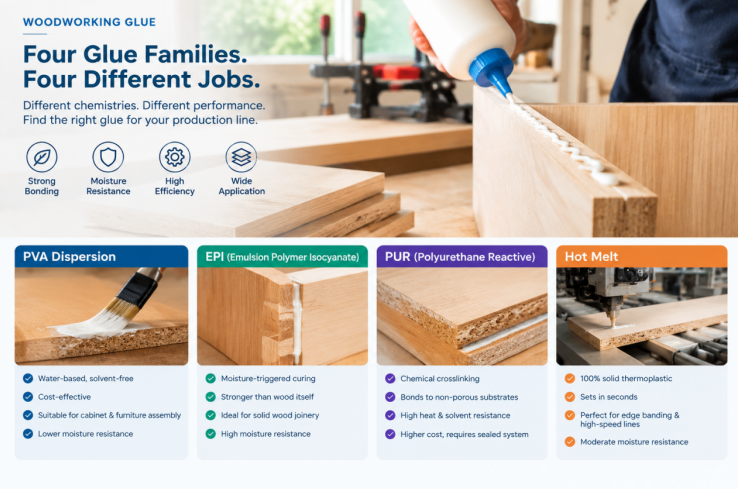
The water-based families you should expect from a serious woodworking adhesive manufacturer are D3/D4 PVA glues, EPI two-part systems, liquid PUR and PUR hot melt, veneer and membrane press adhesives. Our overview of wholesale woodworking adhesives maps each family to the furniture processes it serves, and the woodworking furniture adhesives line page shows the individual grades with technical data.
One practical test: ask the salesperson which grade they would not recommend for your product, and why. Factories with real formulation experience answer with viscosity, open time and press parameters. Resellers answer with a price list.
3. Check 3: Demand Test Reports Before You Ask for Samples
Samples are easy to send and easy to fake. Reports are harder. Before any sample ships, ask for the standard document set: SDS, typical technical data sheet, and a recent certificate of analysis from an actual production batch — not a laboratory-made “golden sample.”
Read the COA against the TDS. The solids content, viscosity and pH on the batch certificate should sit within the ranges printed on the data sheet. A batch sitting far below the stated solids is a sign of inconsistent production, and that inconsistency will land in your glue line sooner or later.
If you export children’s furniture or sell into regulated chains, add the compliance documents to this same request — free-formaldehyde, EN 71-3 and REACH files. We cover that file pack in detail in our low-formaldehyde adhesive guide for kids’ furniture.
4. Check 4: Run a Bonded-Panel Trial on Your Own Line
A glue that performs in the supplier’s lab means nothing until it meets your wood, your spread rate, your press and your workshop temperature. Insist on a trial with your own materials before committing to a container.
- Run at least three press cycles on your normal production schedule, including your worst-performing wood species.
- Measure wet and dry bond strength, and check squeeze-out for color lines on light woods.
- Stress the joints: soak-dry cycles for anything near moisture, heat exposure near windows or in trucks.
- Have the line crew score open time and machining behavior — sanding, planing, tool fouling. Operators find problems engineers miss.
KONSENT supports these trials with a technical engineer on video call, and we adjust viscosity or press recommendations on the spot rather than shipping a “hope it works” drum.
5. Check 5: Confirm OEM and Packaging Options in Writing
If you resell under your own brand, OEM is normal business for Chinese factories — but get the details in the proforma invoice, not in a chat message: label design and language, pail sizes (1 kg, 4 kg, 20 kg, 50 kg, 1200 kg IBC), carton markings, and who owns the artwork. Clarify whether OEM orders carry a higher MOQ and longer lead time than KONSENT-branded stock.
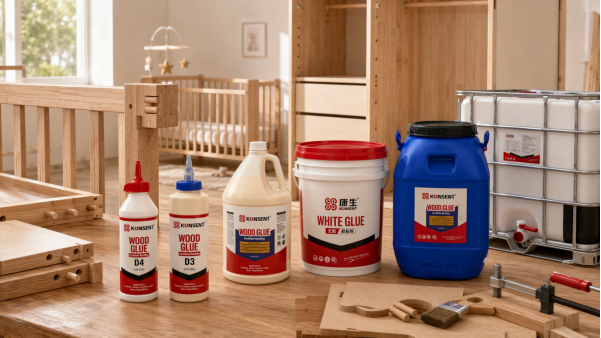
Packaging choice also drives landed cost. Small pails cost more per kilogram in freight and materials, while IBC totes cut packaging waste dramatically for factories that consume glue daily. Ask the supplier to quote the same volume in two packaging configurations so you can see the spread.
6. Check 6: Nail Down MOQ, Lead Time and Liquid Shipping
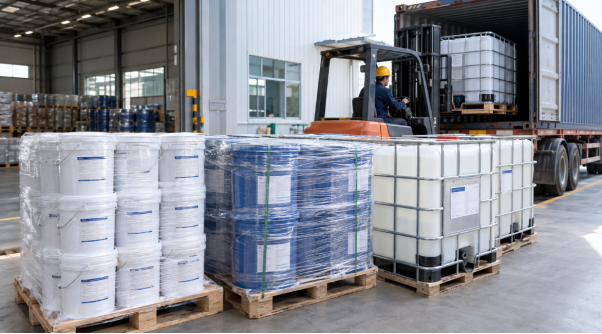
Adhesive is a liquid chemical, and that changes the shipping conversation. Water-based glue is non-dangerous for most forwarders, but it is heavy, and improper declarations cause port delays. Confirm four things in writing before paying:
- MOQ per grade — typically 1 ton per item for standard products, more for OEM colors or viscosities.
- Lead time — standard grades usually ship in 7–15 days after deposit; custom formulations need lab time first.
- Shipping terms — FOB vs CIF, and whether the supplier has exported liquid cargo to your port before.
- Shelf life and storage — water-based adhesives typically carry 6–12 months shelf life. Ordering a year of stock at once is a false economy.
Price negotiation deserves its own preparation. Before you start, work through the questions in our guide to buying wood adhesive in bulk — it lists the payment, retained-sample and compensation clauses that protect you when a batch underperforms.
7. Check 7: Lock Batch Consistency and After-Sales Support
The first container usually goes well. What separates a real partner is container number six. Before signing, require three commitments:
- Retained samples from every batch, kept for the full shelf life, with the batch number printed on each drum you receive.
- Advance notice on any formulation or raw-material change that affects viscosity or solids.
- A named technical contact — not a rotating salesperson — who answers within one working day when your line hits a problem.
Then test the promise early: place a small repeat order and compare its COA against the first batch. Consistency across orders is the single best predictor of how the relationship will behave under pressure.
8. Red Flag Summary
| What You See | What It Usually Means |
|---|---|
| No COA, or COA that never matches the TDS | Inconsistent production — strength and open time will drift between batches |
| Refuses a live factory video tour | Trader, or a factory with something to hide |
| Price far below every other quote | Watered-down solids or off-spec raw materials; the savings leave on the first warranty claim |
| No batch numbers on drums | No traceability — nobody can investigate a field failure |
| Answers only from sales, never an engineer | No technical depth behind the product |
9. Frequently Asked Questions
9.1 Is water-based woodworking adhesive safe to ship by sea?
Yes. Standard PVA and EPI emulsions are non-hazardous goods for ocean freight. Your supplier should still provide an MSDS and a non-dangerous-goods declaration for the forwarder.
9.2 What is a realistic MOQ for imported wood glue?
Factories usually set 1 ton per standard grade, or a full pallet for mixed loads. OEM labels and custom viscosities typically start higher. If a supplier claims “no MOQ at any price,” ask where the drums are actually filled.
9.3 How do I verify a Chinese factory without flying there?
A live video tour, business license check, third-party audit report, and a small trial order with batch-numbered drums cover most of the risk. Many of our customers do the full qualification remotely and visit only after the relationship is proven.
9.4 How long does the whole qualification take?
Documents and samples: 1–2 weeks. Line trial: a few days of production. First order and shipping: 3–5 weeks depending on your port. Budget 6–8 weeks from first contact to the first container in your warehouse — do not compress the trial stage.
10. Start Your Supplier Evaluation
Use this checklist on any supplier you are considering — and ask us the same questions. We will send the document pack, run a bonded-panel trial with your board, and quote your volume in the packaging configuration that fits your line. Contact KONSENT to start the evaluation — technical replies within one working day.