Paper is a living material. It breathes, absorbs moisture, and constantly expands and contracts with its environment. When you bond paper, you are not simply joining two static surfaces. You are managing a dynamic, porous network of cellulose fibers.
This article explores the material science of the paper packaging adhesive. We are moving beyond the simple mechanics of sealing a finished box flap. Instead, we are looking at the fundamental substrate science of paper converting: manufacturing laminated paperboards, creating paper-to-plastic film composites, and forming pressed paper trays. Understanding how adhesives interact with the physical properties of paper is the key to preventing delamination, warping, and manufacturing failures.
When exploring the broader landscape of our packaging glue guide for adhesive families and selection, substrate science takes center stage. A glue that perfectly seals a corrugated carton might completely fail when asked to laminate a glossy film to a printed paper sheet. To build better packaging materials, we must start by looking at the fibers themselves.
Table of Contents
- The Science of Paper Bonding vs. Film Bonding
- Adhesive Families for Paper Converting
- The Paper-to-Plastic Transition: Lamination Challenges
- Working with Coated, Printed, and Re-pulped Substrates
- Paper Tray and Food Packaging Sealing
- Conclusion
1. The Science of Paper Bonding vs. Film Bonding
To choose the right paper converting adhesive, you must first understand how paper accepts liquid compared to other packaging substrates. Paper relies on mechanical adhesion, while films and plastics rely on chemical adhesion.
1.1 The Porous Nature of Cellulose Fibers
Paper is effectively a microscopic sponge. It consists of interwoven cellulose fibers with vast networks of empty space between them. When a liquid water-based adhesive is applied to raw paper, the water acts as a carrier. It pulls the adhesive polymers deep into this porous network.
Once the water evaporates or absorbs further into the substrate, the solid adhesive polymers are left behind, wrapped tightly around the individual paper fibers. This creates a mechanical interlock. The glue has physically woven itself into the paper. In a successful paper-to-paper bond, the adhesive penetrates so deeply that trying to pull the two sheets apart will tear the paper fibers themselves. This is known as a substrate-failing bond, or fiber tear.
Plastic films, on the other hand, have zero porosity. There are no holes for the glue to enter. Bonding to film requires the adhesive to sit entirely on the surface and bond through chemical attraction.
1.2 Moisture, Sizing, and Hygroscopic Movement
Paper is hygroscopic. This means it constantly absorbs water from humid air and releases water into dry air. As it absorbs moisture, the fibers swell. As it dries, the fibers shrink.
Because water-based adhesives introduce localized moisture to the paper, they cause the paper fibers in that specific area to swell. If the paper is laminated to a rigid substrate or a plastic film that does not swell, the resulting tension causes the finished product to curl or warp as it dries.
To control this moisture absorption, paper mills treat the surface of the paper with chemicals and starches. This treatment is called sizing. Sizing resists water penetration to keep ink from bleeding, but it also actively blocks water-based adhesives from penetrating the fibers. A heavy application of sizing requires an adhesive engineered with specific wetting agents to break through the chemical barrier.
2. Adhesive Families for Paper Converting
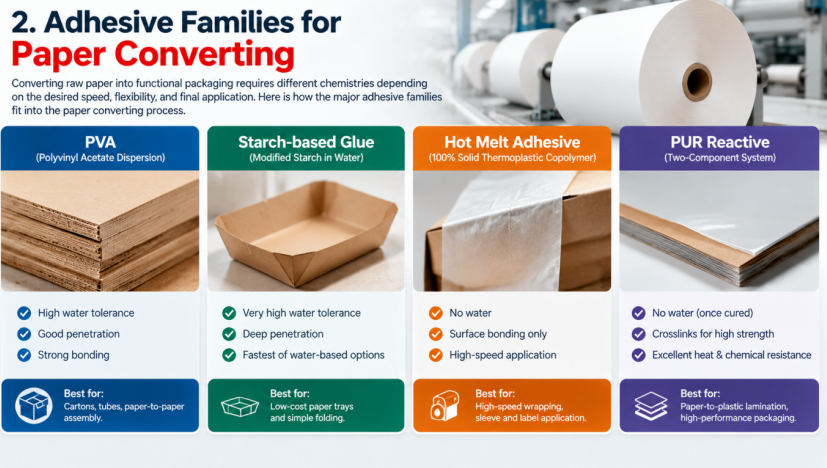
Converting raw paper into functional packaging requires different chemistries depending on the desired speed, flexibility, and final application. Here is how the major adhesive families fit into the paper converting process.
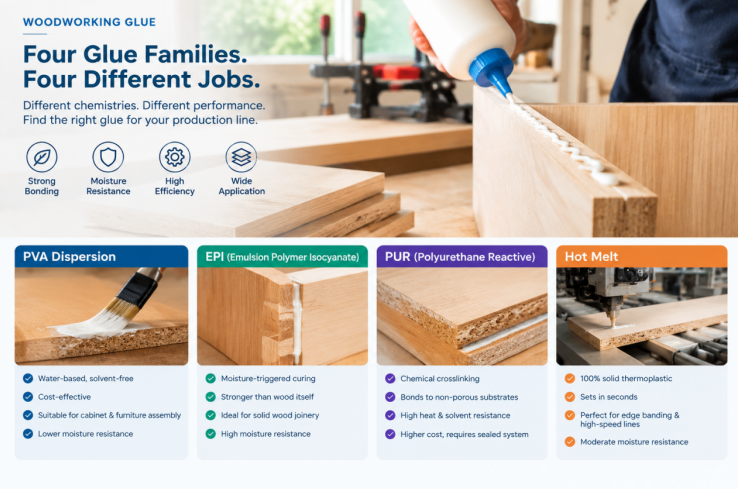
| Adhesive Family | Chemistry | Water Tolerance | Behaviour on Paper | Typical Converting Use |
|---|---|---|---|---|
| PVA dispersion | Aqueous polyvinyl acetate | High | Penetrates fibre, then dries rigid | Cartons, tubes, paper-to-paper assembly |
| Starch-based glue | Modified starch in water | Very high | Deep penetration; fastest of the water-based options | Low-cost paper trays and simple folding |
| Hot melt adhesive | 100% solid thermoplastic copolymer | None once set | Surface bond only; sits on the fibre | High-speed wrapping, sleeve and label application |
| PUR reactive | Two-component polyurethane | None once cured | Crosslinks in the fibre for a permanent bond | Paper-to-plastic lamination, moisture-exposed packs |
PVA and starch glue absorb into the sheet and then lock the two surfaces together mechanically, which is why they tolerate a porous, absorbent substrate so well. Hot melt never penetrates; it wets the surface and cools into a solid skin, so it needs a smoother or coated stock to hold. PUR sits between the two, chemically crosslinking with moisture in the substrate.
2.1 PVA Dispersions
Polyvinyl Acetate (PVA) is the undisputed workhorse of paper bonding. These water-based white glues offer excellent machining properties and deep penetration into porous fibers.
PVA adhesives cure as their water content is absorbed into the paper. They dry clear, remain relatively rigid, and provide exceptional fiber tear on uncoated paper stocks. For standard paper-to-paper lamination, core winding, and folding carton manufacturing, PVA provides the most cost-effective and reliable mechanical bond.
2.2 Starch-Based Glues
Derived from corn, potato, or wheat, starch adhesives are the oldest family of paper glues. They require heat to activate and rely heavily on water evaporation to set.
While they lack the water resistance and flexibility of synthetic polymers, starch adhesives are highly economical and completely biodegradable. They are primarily used in the manufacturing of corrugated board, where massive heated rollers drive the moisture out of the starch to create an instant, rigid bond between the fluted inner paper and the flat outer liners.
2.3 Hot Melt Adhesives
Hot melt adhesives are solid at room temperature. They are melted in a heated tank, applied as a hot liquid, and cure instantly as they cool. They contain no water and therefore do not cause paper fibers to swell or warp.
Because they cure in seconds, hot melts are ideal for high-speed manufacturing lines. However, because they cool quickly, they do not penetrate deeply into paper fibers. They sit on the surface. A standard hot melt acts as a fast-grabbing paper bonding adhesive but generally lacks the extreme temperature resistance required for demanding environments.
2.4 PUR (Polyurethane Reactive)
PUR adhesives are applied hot like a standard hot melt, but they undergo a secondary chemical reaction. Once applied, PUR draws microscopic amounts of moisture from the paper and the surrounding air to cross-link its polymer chains.
This curing process creates an unbreakable, thermosetting bond. PUR will not remelt under heat and resists nearly all solvents. It is the adhesive of choice for demanding structural paper converting, heavy bookbinding, and luxury packaging where failure is unacceptable.
3. The Paper-to-Plastic Transition: Lamination Challenges
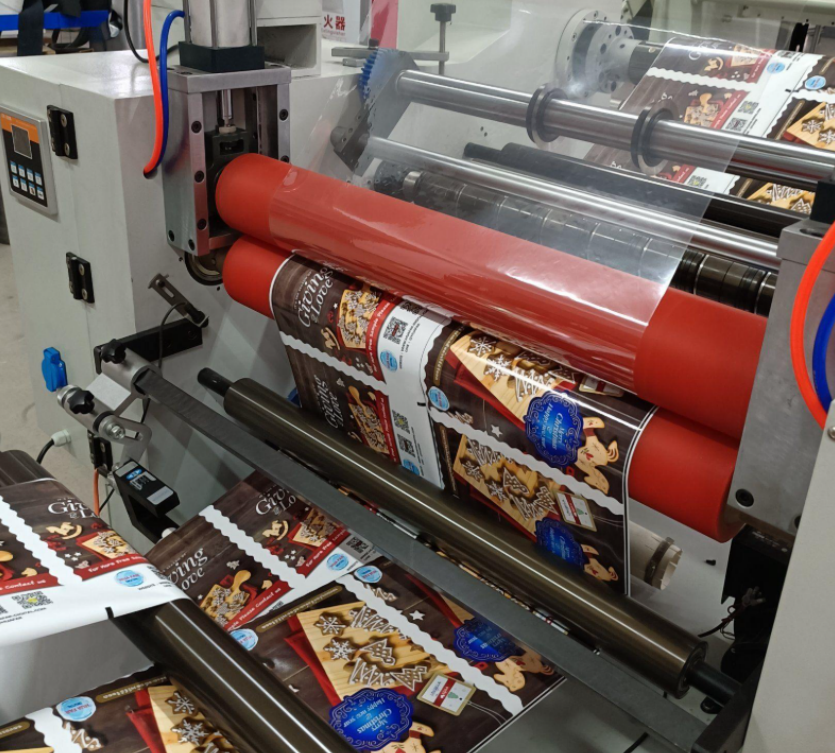
The most complex challenge in modern packaging is combining the natural, porous world of paper with the synthetic, non-porous world of plastic film. Creating windows in cartons, laminating glossy protective films over printed paperboard, or manufacturing flexible composite pouches requires a highly specialized paper plastic bonding adhesive.
3.1 Surface Energy and Non-Porous Films
Common packaging films like BOPP (Biaxially Oriented Polypropylene), PET (Polyethylene Terephthalate), and PE (Polyethylene) are naturally hydrophobic. They repel liquids.
In adhesive science, this is measured as surface energy (dyne level). For a liquid adhesive to stick to a surface, the adhesive must have a lower surface tension than the substrate’s surface energy. Because plastics have inherently low surface energy, standard water-based paper glues simply bead up on the surface like water on a waxed car. They refuse to spread out and “wet” the film.
To overcome this, plastics must be corona treated—hit with a high-voltage electrical discharge that oxidizes the surface and temporarily raises its surface energy. Even with treatment, the adhesive must be formulated with specific chemical anchoring agents that grip the plastic on a molecular level.
3.2 Overcoming Film Tension and Creep
When a thin plastic film is stretched over a paper substrate and glued down, the film naturally wants to shrink back to its original size. This pulling force creates constant sheer stress on the adhesive layer, a phenomenon known as creep.
If the adhesive remains too soft, the film will slowly slide or peel away from the paper edges over time. The formulation must strike a perfect balance: it must wet out the plastic chemically, penetrate the paper mechanically, and cure with enough internal strength to hold the stretched film in place indefinitely.
For high-gloss retail boxes, shopping bags, and flexible pouches, a dedicated BOPP laminating glue is formulated exactly for this purpose. These acrylic or modified-EVA formulations bridge the gap between mechanical fiber penetration and chemical film adhesion. To understand the exact polymer dynamics involved in securing these synthetic films, review our technical breakdown on laminating adhesive for BOPP and PET films.
4. Working with Coated, Printed, and Re-pulped Substrates
The paper you bond in a converting facility is rarely pristine, raw cellulose. It is often covered in chemicals, printed with heavy inks, or manufactured from previously used fibers. Each of these variables dramatically changes how an adhesive performs.
4.1 Inks, Varnishes, and Coatings
When bonding printed paper, the adhesive is no longer touching paper. It is touching dried ink, UV varnish, or aqueous coating.
These coatings seal the pores of the paper. A standard water-based PVA will sit on top of the ink and eventually dry, but it will not achieve fiber tear. Furthermore, the solvents in certain adhesives can react with printing inks, causing the colors to bleed, shift, or ghost through to the other side of the paper. Adhesives used on printed stock must be aggressively formulated to bite through the ink layer without dissolving the pigments.
4.2 Managing Bleed-Through and Blocking
In high-speed paper lamination, especially with thinner decorative papers, moisture control is critical. If a water-based adhesive is too thin (low viscosity) or applied too heavily, the water will carry the adhesive polymers straight through the paper sheet to the other side. This is called bleed-through.
When these freshly glued and laminated sheets are stacked on pallets in a converting facility, the heavy pressure of the stack forces any bled-through adhesive to stick to the sheet above it. This results in blocking—the entire stack fuses into a solid brick of ruined paper. Preventing blocking requires an adhesive with high solids content, which delivers more tack with less water, keeping the glue exactly where it belongs.
4.3 Secondary Fiber Substrates
Modern packaging relies heavily on paperboard made from secondary, previously used fibers. While excellent for sustainability, these substrates present unique mechanical challenges.
Every time paper is repulped, the cellulose fibers break down and become shorter. Shorter fibers result in a board with lower internal strength, specifically in the Z-direction (pulling the layers apart). Additionally, these boards often contain residual sizing, inks, and clay from their previous lives. A specialized paper lamination adhesive must have high initial tack to grab these short, dusty fibers instantly without pulling the delicate board layers apart during the converting process.
5. Paper Tray and Food Packaging Sealing
As the packaging industry shifts away from single-use plastics, pressed paper trays, molded pulp containers, and folded paperboard clamshells are taking over the food sector.
Formulating a paper tray sealing glue introduces a new set of environmental demands. These trays frequently hold hot, steaming food, or they are stored in refrigerated display cases where condensation is constant. The adhesive must resist high humidity and extreme temperature swings without softening.
More importantly, any adhesive used in food packaging must navigate strict regulatory frameworks. Even if the glue does not touch the food directly, the heat from a microwave or the moisture from a refrigerator can cause adhesive chemicals to migrate through the porous paper fibers and enter the food supply. Formulators must therefore test their products against the established food-contact frameworks and keep that documentation on file, because the paperwork is what demonstrates consumer safety and rules out chemical migration.
| Bond Type | Substrate Pair | Governing Factor | Typical Failure |
|---|---|---|---|
| Paper to paper | Uncoated to uncoated | Fibre penetration and surface energy | Weak joint in humid conditions |
| Paper to paper | Coated or printed board | Coating blocking penetration | Edge lift and delamination |
| Paper to film | BOPP, PET, or PE | Surface energy and dyne level | Beading and poor wet-out |
| Paper to plastic | Non-porous film | Corona treatment and anchoring chemistry | Film peels off cleanly |
| Tray seal | Bleached or recycled board | Edge wetting and compression | Corner opening in transit |
Surface energy is measured in dyne levels. A liquid adhesive can only wet a substrate when its own surface tension is lower than the substrate surface energy, which is why untreated polyolefin films bead up like water on a waxed car and why corona treatment is used to raise the surface energy of BOPP, PET and PE before lamination.
6. Conclusion
The performance of paper packaging rests entirely on the unseen layer of adhesive holding it together. Whether you are laminating rigid corrugated boards, bonding high-gloss BOPP films to printed retail cartons, or forming molded paper food trays, success requires matching the adhesive chemistry to the physical reality of the substrate.
Paper is porous, hygroscopic, and constantly variable. Plastics are non-porous and high-tension. Bridging these differences requires precise polymer engineering. If you are experiencing delamination, blocking, or warping on your converting lines, the solution usually lies in adjusting the solid content, viscosity, or wetting agents of your glue. Feel free to contact our technical team to discuss the specific substrate challenges on your manufacturing floor, and we can help you identify the precise formulation needed to keep your packaging flawless.
FAQ
Why does paper-to-plastic bonding fail?
Standard water-based glues rely on soaking into pores to create a bond. Because plastic films have no pores and low surface energy, standard glue simply dries on the surface without anchoring. Film bonding requires specialized adhesives that chemically bite into the plastic while resisting the natural shrinkage and tension of the film.
Why does adhesive bleed through or warp absorbent paper stock?
Bleed-through happens when the adhesive viscosity is too low, the application is too heavy, or the paper is too thin and unsized. The excess water carries the glue entirely through the sheet. This excess moisture also causes the cellulose fibers to swell dramatically, which leads to warping as the paper eventually dries.
How do you stop finished paper packs from blocking / sticking together in converting?
Blocking is prevented by controlling moisture. Use an adhesive with a higher solids content (less water) to reduce bleed-through. You can also apply a thinner coat weight, increase drying time before stacking, or reduce the physical pressure on the stacked pallets.
Does the bond affect repulpability and recyclability of the pack?
Yes. When a laminated paper pack is recycled, the adhesive must either dissolve completely or screen out of the paper pulp easily. Starch and standard PVA adhesives generally break down well in recycling facilities. Complex hot melts or PUR adhesives require specialized screening to separate them from the reusable paper fibers.
What is the difference between paper bonding and carton sealing?
Paper bonding (or converting) is the process of manufacturing the raw packaging material itself—such as laminating two sheets of paper together or adhering a plastic film to paperboard. Carton sealing is the final step of closing the flaps of a finished, folded box to secure the product inside.
How does surface sizing affect paper bonding?
Sizing is a chemical or starch treatment applied to paper to make it water-resistant. Because water-based adhesives need to penetrate the paper fibers to work, heavily sized paper acts as a barrier, causing the glue to dry too slowly or fail to anchor. Adhesives for sized paper require special wetting agents to cut through this barrier.
Why do paper laminations curl after drying?
Curling is caused by moisture imbalance. When wet adhesive is applied to paper, the localized fibers absorb water and swell. If that paper is laminated to a plastic film or a rigid board that does not swell, the subsequent shrinking of the drying paper creates tension, pulling the finished composite into a curled shape.