A pop-open on the cartoning line is a quality problem. A bubble in the veneer on a door panel is a different order of problem, because the panel has already been cut, sanded, and finished before anyone sees the defect. By the time a bubble appears on a finished door, the labour is already spent and the panel has to go back to sanding.
Veneer lamination is the one woodworking process where a perfectly good adhesive still fails. The bond depends on four numbers that have to be right together: the coat weight, the press temperature, the press time, and the moisture condition of the veneer itself. Get one of them wrong and the joint fails no matter which glue you bought. Get all four right and almost any qualified adhesive will perform.
This guide is written for the person who specifies that line, usually a production engineer or a factory manager who has to defend the specification to a supplier. It covers what each parameter does, which adhesive family fits which process, what the five common failures actually tell you, and what to write into the purchase order so the grade cannot quietly change.
Table of Contents
- Why Wood Veneer Adhesive Fails When the Glue Is Not the Problem
- The Four Parameters That Decide the Bond
- Matching the Wood Veneer Adhesive Family to the Press You Own
- What to Ask a Supplier Before You Approve a Veneer Grade
- Five Failures and What Each One Is Telling You
- Trial Protocol for a New Veneer Grade
- What to Write Into the Wood Veneer Adhesive Purchase Order
- Where Veneer Bonding Sits Against the Rest of Your Line
- Conclusion
1. Why Wood Veneer Adhesive Fails When the Glue Is Not the Problem
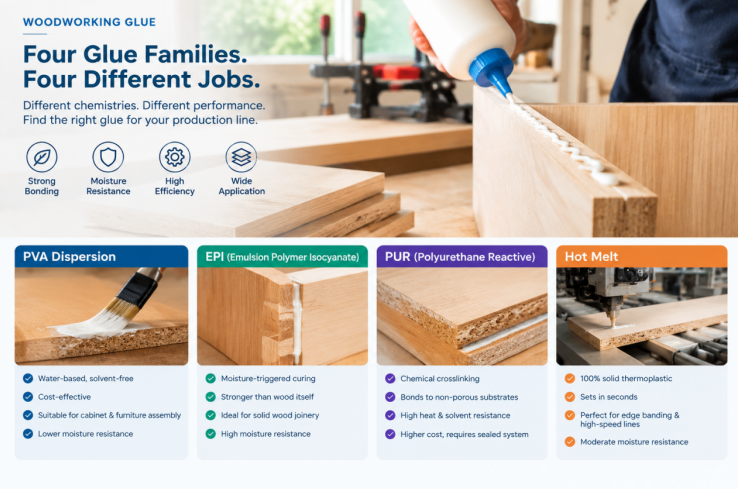
Veneer is a thin, dry, porous sheet. The substrate underneath it may be particleboard, MDF, plywood, or solid wood, and each of those drinks adhesive at a different rate. When the glue is applied, some of it soaks into the substrate and some of it stays at the surface. The part that stays at the surface is what becomes the glue line.
If too little stays at the surface, you have a starved glue line and the veneer lifts along the edge first, because that is where the adhesive film is thinnest. If too much water is delivered and the press cannot remove it in the cycle you set, you have trapped moisture, and trapped moisture becomes a bubble when the panel later sees heat.
Neither of those failures is caused by a bad adhesive. They are caused by an unqualified combination of coat weight and press cycle, which is why the same glue can perform perfectly on one line and fail on another.
| Failure | What You See | What It Actually Means |
|---|---|---|
| Edge lift | Veneer peels at corners and seams | Starved glue line; coat weight below qualified window |
| Bubbling | Raised blisters across the face | Trapped moisture; press time too short for the coat weight |
| Seam telegraphing | Joins show through the finish | Uneven coat weight or uneven pressing across the panel |
| Delamination in service | Bond fails months later in humidity | Adhesive family wrong for the service condition, not for the press |
| Bleed-through | Dark marks on light veneer | Over-application or too much squeeze-out left uncured |
Reading the failure correctly matters more than reading it quickly. An edge lift tells you the coat weight is low. Bubbling tells you the press time is short. If you respond to bubbling by raising the coat weight, you will create both problems at once.
2. The Four Parameters That Decide the Bond
Almost every veneer bonding question reduces to these four. If all four are specified, the adhesive choice becomes the easy part.
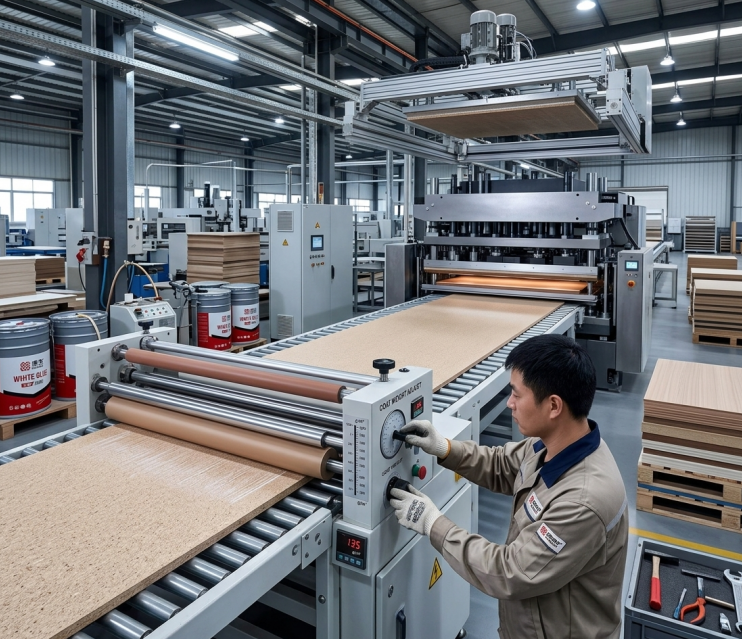
Coat weight. How much adhesive goes on, in grams per square metre. This is the single most consequential number on the line, and it is the one most often left vague. Below the qualified window you get a starved line; above it you get squeeze-out and, on porous substrates, longer time to lose the water.
Press temperature. How hot the platens are. Temperature governs how fast the adhesive flows and how fast moisture leaves. Raising temperature to compensate for a too-short cycle is a common shortcut that trades one failure for another.
Press time. How long the panel stays under pressure. This has to be long enough to remove the water in the coat you just laid down, and the water in the coat is a function of your coat weight. The two numbers cannot be set independently.
Veneer moisture and room conditions. Veneer that arrives wet will outgas after lamination. Veneer that arrives too dry can absorb adhesive too fast and starve the line. Ambient temperature and humidity at the press change the result as well, which is why a grade qualified in a dry winter can behave differently in a humid summer.
3. Matching the Wood Veneer Adhesive Family to the Press You Own
Veneer adhesive families are not interchangeable, and the press you already own narrows the choice before quality ever enters the conversation.
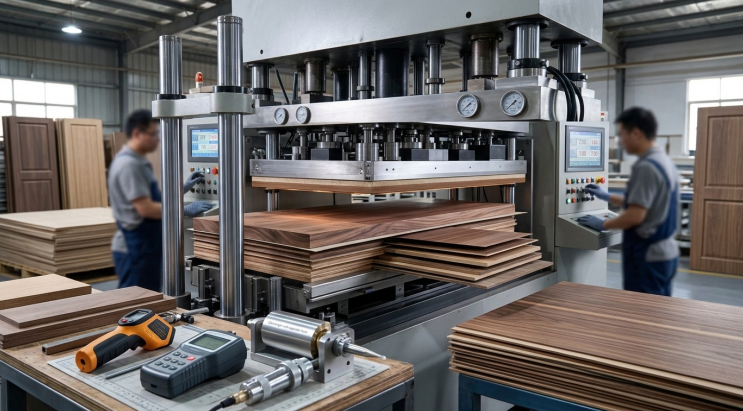
Hot press PVAc. The classic veneering adhesive for continuous hot presses and flat platen presses. It sets fast, tolerates the high platen temperatures, and gives a rigid glue line that does not creep. It needs a properly conditioned press and controlled veneer moisture.
PUR and EPI. Moisture-crosslinking systems. They bond well to veneer without the heat window a hot press demands, which makes them useful on cold presses and low-temperature laminating. They cost more per kilo and PUR needs a sealed applicator so it does not cure in the tank.
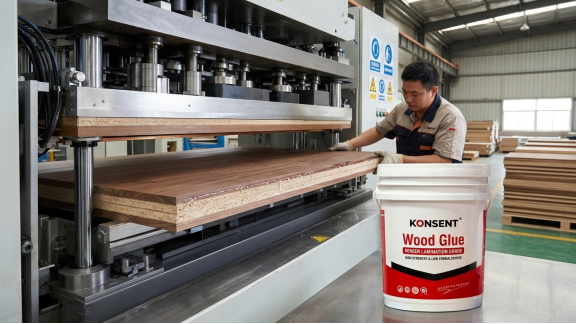
Contact and PSA systems. Used for high-pressure laminates and some paper-backed veneers rather than natural veneer. Not a substitute for a structural veneer bond, and worth being explicit about that with anyone who asks.
| Factor | Hot Press PVAc | PUR / EPI |
|---|---|---|
| Press type required | Hot or flat platen | Cold or low-temperature |
| Set behaviour | Rapid, heat-driven | Moisture-crosslinking |
| Veneer moisture sensitivity | High | Lower |
| Peel strength on veneer | High, rigid line | High, slightly more flexible |
| Applicator | Nozzle, roller, or spray | Sealed tank required for PUR |
| Cost position | Lower per kilo | Higher per kilo |
A factory that owns only a cold press cannot run a hot press PVAc efficiently, and a factory running three shifts on a hot press will usually be better served by a grade qualified for that press than by a premium cold-press product. The wider range of veneer and laminating grades, and what each one is qualified for, is set out in the woodworking and furniture adhesives range.
4. What to Ask a Supplier Before You Approve a Veneer Grade
Send the substrate, the veneer, and the press conditions together, and ask for a written qualification against your actual numbers. If a supplier will not state the coat weight they qualified at, they have not qualified anything.
- At what coat weight in grams per square metre did you qualify this grade on our veneer thickness?
- What platen temperature and press time did you qualify at?
- What veneer moisture content did the qualification run at?
- What is the acceptable coat weight window, and how wide is it?
- How long can the adhesive sit in the pot or nozzle before it skins or gels?
- What happens if the batch arrives outside the viscosity range you qualified?
The sixth question is the one that saves a production week. Veneer lines run long, and a grade that needs its pot cleaned every eight hours because viscosity drifts does not survive contact with a real schedule.
That question is also the quickest way to test whether you are talking to a producer. KONSENT has manufactured adhesives in Dongguan since 2011, on 10, 20, and 50-ton Siemens DCS automated lines with roughly 100,000 tons of annual capacity, dosing raw materials from Kuraray, Chang Chun, Celanese, Wacker, BASF, and Covestro under ISO 9001 with REACH and RoHS documentation. Production capacity of that kind is why a batch certificate can be produced for the drum in your warehouse rather than for a sample drum sent last year. A supplier who cannot trace your drum back to a production date has no traceability to offer you, whatever the product literature says.
5. Five Failures and What Each One Is Telling You
When a veneer line starts rejecting panels, the failure pattern usually identifies the parameter that moved. Read the pattern, not just the defect.
Bubbles across the face almost always mean trapped moisture. Press time is short for the coat weight, or the coat weight was raised without extending the cycle. Extending press time is the fix; adding more adhesive makes it worse.
Edge lift at corners and seams means the glue line is starved. Coat weight is low, or the substrate is too porous and drank the adhesive before it could set. A coat-weight increase is the fix.
Seams telegraphing through the finish means unevenness, usually a roller that is worn or an inconsistent spread across the panel width. This is an application problem, not an adhesive problem.
Delamination appearing months later means the adhesive family was chosen for the press rather than for the service condition. A panel destined for a bathroom or a coastal climate needs a crosslinking grade, regardless of what the press can run.
Bleed-through on light veneer means over-application with squeeze-out left in contact with the face long enough to stain it. Faster cleanup solves it; more adhesive makes it worse.
6. Trial Protocol for a New Veneer Grade
Run the new grade on production panels, not sample coupons. Veneer behaviour on a coupon is not predictive, because a coupon has one face and one fibre direction while a real panel has both.
- Cut a full panel of production veneer and label it with the batch number before anything else happens.
- Run three panels, not one. The first panel off a new drum is frequently off-spec because the drum surface has not been wetted in yet.
- Record coat weight, platen temperature, and press time for every panel, written down at the machine.
- Check the first panel after 24 hours, not off the press. A bond that looks good at demoulding and fails overnight was under-cured.
- Keep the panels. When the first full production run happens three weeks later, you want the trial panel and the production panel in the same hand.
7. What to Write Into the Wood Veneer Adhesive Purchase Order
A quotation for veneer adhesive should carry seven items, and five of them are not price.
- Coat weight window in grams per square metre
- Press temperature and press time the grade was qualified at
- Veneer moisture range for the qualification
- Pot life or application window before the material skins
- Storage temperature limits and shelf life
- Whether a retained sample is provided per batch
- Incoterms, lead time, and who bears freight and duty
Items one to three are what make the specification enforceable. Without them, “veneer adhesive” is a product category rather than a specification, and any compliant product technically satisfies the order.
8. Where Veneer Bonding Sits Against the Rest of Your Line
Veneer is often treated as one process among several, but it behaves differently from the others in a way that matters for how you buy.
Cabinet carcasses and drawer assembly run water-based adhesives on porous substrates and forgive small process variation. Veneer lamination does not forgive it, because the glue line is visible on the finished face and the substrate porosity varies across a single panel.
If you are standardising adhesives across the plant, veneer is the last place to make that change. Qualify it separately, on real panels, with its own coat weight and press cycle written down. The wider question of which adhesive family belongs on which line is covered in the woodworking glue overview
, and the substrate that most often defeats veneer is the one covered in MDF glue.
Conclusion
Specifying wood veneer adhesive is a matter of four numbers: coat weight, press temperature, press time, and veneer moisture. Qualify the grade against those numbers on production panels, keep the sample from every batch, and write the numbers into the order so the product cannot change underneath you. If you send us your veneer thickness, your substrate, and your press cycle, our technical team will return a qualification recommendation with the coat weight and cycle we would trial, rather than a product list.
FAQ
What coat weight should I use for wood veneer adhesive?
The figure has to come from a qualification on your actual veneer and substrate, because veneer thickness and substrate porosity change it substantially. Treat any supplier’s number as the centre of a window rather than a single value, and re-check the window when you change either the veneer supplier or the substrate grade.
Can I use one veneer adhesive on both a hot press and a cold press?
Rarely, and it is worth resisting the temptation. A hot press PVAc is qualified for heat-driven flow at platen temperature, while PUR and EPI are qualified for moisture crosslinking at lower temperatures. Running either outside its qualified press conditions usually produces a bond that looks acceptable and fails in service.
Does veneer moisture content affect the bond?
It affects it significantly. Wet veneer traps moisture in the glue line and outgasses after lamination, which shows up as bubbling later. Over-dry veneer absorbs adhesive too quickly and starves the line at the edges. Most suppliers will quote a moisture range their grade was qualified in, and that range is the number to hold your incoming veneer to.
Why does veneer bubble on the face but not at the edges?
Bubbling in the middle of the face points at trapped moisture and a press cycle that is too short for the coat weight being applied. The edges dry faster because they are thinner and more exposed, so the problem appears in the flat area first. The fix is press time or coat weight, not pressure.
Is PUR veneer adhesive worth the higher cost?
It is worth it when the finished panel sees moisture or heat in service, or when you are laminating onto a non-porous substrate, because PUR crosslinks through a chemical reaction rather than relying on heat alone. On interior flat-pack panels in a dry climate, a qualified hot press PVAc delivers the same bond for less.
How long should a veneer adhesive stay in the pot before it must be replaced?
That figure belongs in the specification, and it is usually much shorter than operators assume. Water-based grades skin and thicken in the pot, and the visible result is a joint that varies along the panel. Ask the supplier for the pot life at your working temperature, write it into the order, and put a cleaning interval on the line schedule rather than waiting for the drift to appear in finished panels.
What is the most common reason a veneer line gets rejected panels?
A coat weight that has drifted away from the qualified window, usually because a roller was replaced with one of a different specification. The adhesive is rarely the cause. Checking coat weight first, then press time, resolves most rejection patterns faster than changing grade.