
Edge banding hides the raw core of particleboard, MDF, or plywood and gives furniture a clean, durable surface. The adhesive holding that tape is out of sight, but its failure is highly visible: peeling tape, raised seams, and discoloration along the edge. For furniture makers producing cabinets, wardrobes, desks, and shelving in high volumes, selecting the right edge banding adhesive is as important as choosing the right tape.
This guide explains how to select an edge banding glue for your production line, from chemistry and heat resistance to machine compatibility and bulk procurement. For a broader view of furniture bonding, see our pillar guide on industrial woodworking adhesives.
Table of Contents
- Why Edge Banding Fails and What It Costs
- EVA vs PUR Edge Banding Adhesive
- Choosing by Substrate and Tape Material
- Machine Settings, Open Time, and Heat Resistance
- Bulk Supply, OEM, and Quality Assurance
- Frequently Asked Questions

Why Edge Banding Fails and What It Costs
Edge banding failure is one of the most common warranty claims in cabinet and furniture manufacturing. It usually shows up months after delivery, when panels are exposed to heat, humidity, or daily handling. The root cause is rarely the tape itself; it is almost always an adhesive mismatch.
Heat is the biggest enemy of a standard edge banding glue. Containers shipped across the equator, cabinets installed near ovens, or desks left in direct sunlight can reach 60–70°C. At that point, a low-grade EVA hot melt begins to soften, allowing the tape to lift. In humid climates, moisture can migrate through the core and weaken the bond line from behind.
Beyond climate, machine variables cause failures. If the adhesive is applied too cold, it does not wet the tape surface. If applied too hot, it degrades and loses green strength. If the feed speed is too high, the glue line becomes too thin and starved. A reliable industrial woodworking adhesive supplier should provide machine parameters, not just a price list.
EVA vs PUR Edge Banding Adhesive
EVA and PUR are the two dominant chemistries for edge banding. EVA is economical and widely used. PUR costs more but offers irreversible bonding and superior durability. The choice should be based on the end-use environment, not just the purchase price.
EVA hot melt is a thermoplastic. It melts in the tank, sets by cooling, and can re-soften if reheated. For low-stress office furniture, shelving, and dry-climate interiors, standard EVA is sufficient. It is also forgiving: long open time, easy cleanup, and compatible with most edge banding machines.
PUR hot melt goes through two stages: initial cooling gives green strength, then moisture cross-linking creates a thermoset bond that cannot be remelted. This makes it the default choice for kitchen cabinets, bathroom vanities, furniture exported to hot climates, and high-traffic commercial interiors. The higher cost per kilogram is usually offset by lower warranty claims and fewer rejected panels.
EVA vs PUR Edge Banding Glue Comparison
| Property | EVA Hot Melt | PUR Hot Melt |
| Bond reversibility | Thermoplastic; can re-soften | Thermoset; irreversible after curing |
| Heat resistance | Good up to ~60°C | Excellent, often >100°C |
| Water/humidity resistance | Moderate | Excellent |
| Open time | Longer, more forgiving | Shorter, requires tuned machine |
| Best applications | Office furniture, dry interiors | Kitchens, bathrooms, tropical export |
| Cost | Lower | Higher, but lower defect cost |
Choosing by Substrate and Tape Material
Different edge tapes place different demands on the adhesive. PVC and ABS tapes are non-porous and require the adhesive to create a strong mechanical and chemical grip on a smooth surface. Wood veneer edge bands are porous and absorbent; a low-viscosity adhesive can soak in too quickly, starving the glue line. For bonding the veneer sheet itself, see our wood veneer adhesive selection guide.
Particleboard and MDF cores are porous. They absorb adhesive like a sponge, which is why unfilled, low-viscosity glues often fail. A filled edge banding adhesive with the right rheology builds a thicker bond line and prevents the glue from disappearing into the core.
High-gloss acrylic or PET tapes have low surface energy. They need an adhesive with excellent wetting and often a slightly longer open time to ensure complete surface coverage. Some applications also benefit from a primer or corona treatment to improve adhesion.
3D profile wrapping and shaped edges need an adhesive with high initial green strength and elasticity. The adhesive must hold the tape in place while the panel moves through trimming and routing stations without spring-back. PUR systems are usually preferred for curved or profile-wrapped edges. For fully shaped 3D doors, see our membrane press adhesive guide.
Machine Settings, Open Time, and Heat Resistance
Even the best edge banding glue will fail if the machine is set wrong. The three settings that matter most are tank temperature, application roller or nozzle pressure, and feed speed.
Temperature: EVA adhesives typically run at 170–190°C; PUR systems run at 120–140°C to prevent premature cross-linking in the tank. Overheating any hot melt causes charring, viscosity drift, and weak bonds. Use a covered tank with nitrogen blanketing for PUR to extend pot life.
Application rate: A common starting point is 25–40 grams per square meter, depending on tape width and core porosity. Too little glue creates a starved joint; too much squeezes out and fouls trimming cutters.
Feed speed: High-speed lines above 20 meters per minute need adhesives with short open times and fast setting speeds. If the adhesive is still tacky when the panel reaches the trimming unit, the tape can shift and create uneven edges. For high-speed production, unfilled formulations with optimized tack are essential.
Bulk Supply, OEM, and Quality Assurance
High-volume furniture factories consume edge banding adhesive by the ton. Batch consistency is critical: a viscosity shift of just a few hundred mPa·s can change coat weight, open time, and final bond strength. Reliable suppliers test every batch for viscosity, softening point, and bond performance and provide TDS and SDS documentation.
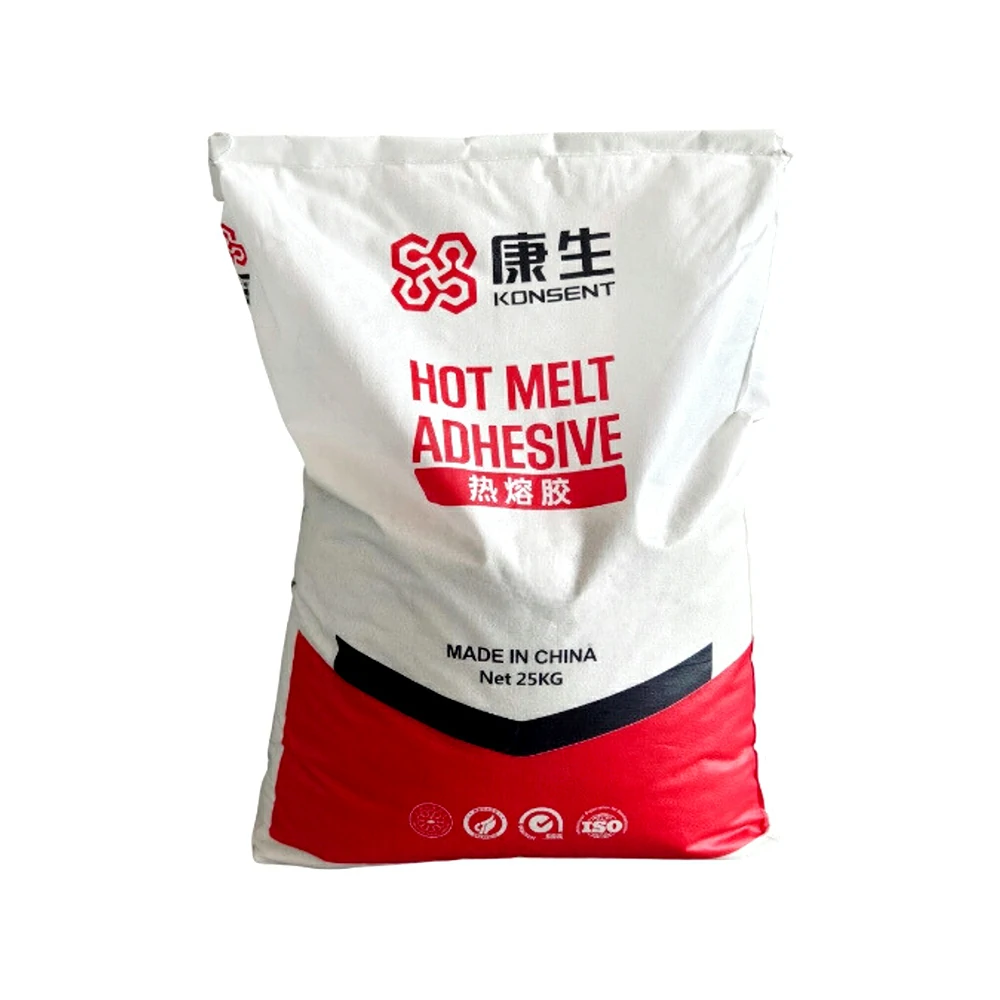
KONSENT manufactures industrial woodworking adhesives in a DCS-controlled plant with automated dosing from premium raw material suppliers. Our edge banding products are REACH and RoHS compliant, and we retain batch samples for three months to support traceability. For OEM customers, we can adjust color, viscosity, open time, and packaging to match private-label requirements.
When evaluating a supplier, ask for real production trials on your own edge banding machine. A sample bond tested in a lab does not always predict performance at your actual feed speed, ambient humidity, and tape type. Technical support during the trial is a strong indicator of long-term partnership quality.
Frequently Asked Questions
What is the strongest adhesive for edge banding?
PUR hot melt generally provides the strongest, most heat- and water-resistant bond for edge banding. Once cured, it forms an irreversible thermoset bond that outperforms standard EVA in demanding environments.
Can I use regular wood glue for edge banding?
No. Standard PVA wood glue dries too slowly and lacks the heat resistance and tack required for high-speed edge banding machines. It also over-penetrates porous cores. Use a dedicated hot melt edge banding adhesive.
Why does my edge banding tape peel off in summer?
Summer heat softens thermoplastic EVA adhesives. If the panel will be exposed to temperatures above 60°C, upgrade to a high-heat EVA or a moisture-curing PUR edge banding adhesive.
What temperature should edge banding glue be applied at?
EVA typically runs at 170–190°C; PUR runs at 120–140°C. Always follow the manufacturer’s TDS and monitor the tank temperature to prevent degradation.
How do I choose between bulk edge banding adhesive and small cartridges?
Bulk pellets are far more economical for continuous production and reduce packaging waste. Cartridges or small blocks are only practical for small workshops or R&D testing.
Improve Your Edge Banding Line with KONSENT
Stop edge tape failures before they reach your customer. KONSENT supplies EVA and PUR edge banding adhesives formulated for high-speed lines, tropical climates, and premium interior finishes. Our technical team can audit your machine settings, recommend the right chemistry, and provide production trials on your actual substrates.
Request a quote or sample today and receive a tailored adhesive recommendation, complete TDS/SDS documentation, and OEM customization options for your private-label furniture program.
