In automotive interior manufacturing, selecting the right Automotive Interior Adhesives is not just about comparing baseline bond strength—it is about matching the chemical delivery method directly to your factory’s production cycle and automation equipment. Choosing the incorrect application method leads to uneven coverage, excessive adhesive consumption, and severe assembly line bottlenecks. Whether utilizing a Spray Automotive Adhesive for large-surface lamination or a Liquid Automotive Adhesive for targeted structural bonding, production engineers must align the adhesive technology with their specific substrates and curing parameters. This technical guide compares spray and liquid application methods, exploring process compatibility and material challenges to help OEM and Tier 1/Tier 2 manufacturers optimize their interior assembly lines.
Table of Contents
- The Role of Application Methods in Automotive Interior Manufacturing
- Technical Characteristics of Spray Automotive Adhesives
- Technical Characteristics of Liquid Automotive Adhesives
- Spray vs Liquid Adhesive: Technical Comparison and Selection Rules
- Application Scenarios: Matching Adhesives to Interior Components
- Evaluating Process Compatibility and Total Production Costs
- Conclusion
1. The Role of Application Methods in Automotive Interior Manufacturing
The best adhesive application method for automotive interior bonding depends entirely on the component’s geometric complexity, the required production speed, and the specific material combinations involved in the assembly.
Modern vehicle cabins are complex composite environments. Manufacturing a single vehicle interior involves integrating PVC films, synthetic leather, acoustic fabric, PU foam, ABS, low-surface-energy PP, and wood fiber boards. Because these materials possess divergent surface energies and thermal expansion coefficients, the way an Automotive Interior Glue is applied directly dictates its bonding consistency and long-term durability.
For manufacturing engineers, the decision between spray and liquid application is driven by production economics and process constraints. Applying an adhesive via the wrong method can cause heavy fluid bleed-through on delicate textiles, or conversely, result in “starved joints” where not enough adhesive is present to secure rigid plastics. Therefore, evaluating your factory’s automation capabilities, coating area requirements, and daily production targets is the first step in formulating a reliable bonding strategy.
2. Technical Characteristics of Spray Automotive Adhesives
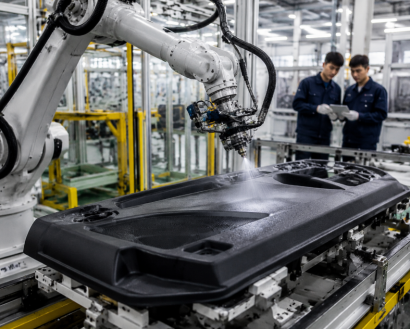
A spray automotive adhesive is engineered for large-surface and complex-curve applications, providing the uniform coverage and rapid processing times necessary for high-volume automated production lines.
Spray application is the dominant method for interior lamination due to its ability to cover large surface areas quickly and consistently. When formulated correctly, these adhesives atomize cleanly through spray guns without stringing or clogging nozzles.
- Uniform Coverage: Spraying generates a thin, highly consistent adhesive layer. This is particularly critical for fabric bonding and foam lamination, where uneven glue lines can cause visible surface defects or bleed-through that ruins the aesthetic finish of the interior trim.
- Flexible Process Integration: Spray adhesives adapt easily to both manual spray booths and advanced robotic dispensing systems. This flexibility allows Tier suppliers to scale production seamlessly from low-volume custom interiors to high-speed mass production.
- Fast Processing Speeds: To maintain assembly line pacing, spray formulations are specifically engineered with highly controlled drying times, optimized open times, and aggressive initial tack. This allows operators to wrap complex geometries and immediately move the component to the next assembly stage without waiting for extended clamping times.
3. Technical Characteristics of Liquid Automotive Adhesives
Liquid automotive adhesives are the preferred solution for applications requiring precise viscosity control, high initial structural strength, and targeted bonding in confined or specific structural areas.
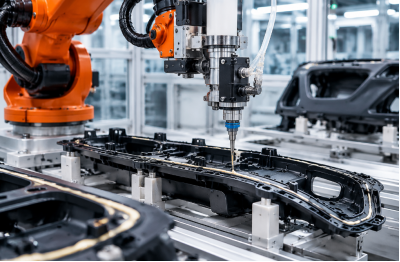
While spray adhesives excel in surface lamination, liquid adhesive solutions for automotive interior assembly are vital for targeted component fixation. Applied via rollers, slot dies, or automated dispensing beads, liquid adhesives offer unparalleled control over fluid placement and volume.
- Viscosity Control: The rheology of a liquid adhesive can be highly customized. Engineers can select high-viscosity gels that resist slumping on vertical surfaces or low-viscosity fluids that flow deeply into mechanical joints. This dictates coating thickness, spreading behavior, and compatibility with specific automated extrusion equipment.
- Targeted Precision: Liquid dispensing allows for exact adhesive placement along narrow channels, mounting clips, and edge wrapping zones where overspray from a spray gun would contaminate adjacent visible surfaces.
- Exceptional Bond Strength: Because liquid adhesives are often applied in thicker beads or controlled layers, they provide massive initial structural strength. They are specifically formulated to deliver the extreme heat resistance and humidity resistance required to bond rigid plastics, leathers, and structural inserts that endure high mechanical stress.
4. Spray vs Liquid Adhesive: Technical Comparison and Selection Rules
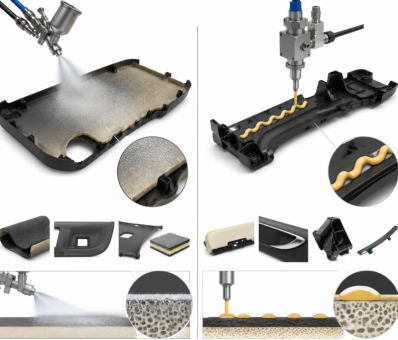
Selecting between spray and liquid adhesives requires evaluating application area, production speed, and layer control; spray methods excel in large-surface lamination, while liquid methods dominate targeted, high-precision assembly.
To make an informed decision, procurement and engineering teams must evaluate how the physical state of the adhesive interacts with their specific factory equipment.
Technical Comparison Matrix
| Evaluation Factor | Spray Automotive Adhesive | Liquid Automotive Adhesive |
| Application Method | Manual spray gun, robotic atomization | Roller coating, slot die, bead dispensing |
| Target Application Area | Large surface bonding, complex 3D curves | Targeted structural bonding, edge folding, narrow channels |
| Production Speed | Very High (rapid coverage of large parts) | Variable (depends on dispensing equipment and curing profile) |
| Adhesive Layer Control | Thin, highly uniform, prevents bleed-through | |
| Typical Interior Uses | Headliners, fabric lamination, foam backing | Plastic brackets, leather wrapping, localized trim assembly |
| Manufacturing Fit | High-volume lamination and surface finishing | Diverse, multi-step structural and targeted assembly |
Engineering Decision Logic:
- Select a Spray Adhesive when: Your process involves laminating textiles, PVC, or foam over large, contoured surfaces (like a dashboard or headliner) where adhesive uniformity is required to prevent visual defects.
- Select a Liquid Adhesive when: Your process involves mounting rigid plastic components, edge-wrapping leather around tight radii, or injecting adhesive into specific grooves where overspray cannot be tolerated.
5. Application Scenarios: Matching Adhesives to Interior Components
Automotive interior manufacturing utilizes both spray and liquid adhesives depending on the component; spray is heavily used for dashboards and headliners, while liquid is utilized for localized door panel and trim reinforcement.
By analyzing specific vehicle components, manufacturers can identify the most efficient bonding strategy for their production lines.
5.1 Automotive Door Panel Assembly
Door panels are complex multi-material composites. They involve bonding acoustic foam and decorative fabric to rigid ABS or PP substrates.
- Spray Application: Used to quickly laminate the large textile and foam sections onto the main door carrier, ensuring no heavy glue spots show through the fabric.
- Liquid Application: Utilized for localized reinforcement, such as securing rigid plastic armrest brackets, attaching speaker grilles, or edge-folding synthetic leather around the panel perimeter.
5.2 Dashboard and Instrument Panel Bonding
Manufacturing a dashboard frequently involves marrying a PVC or TPO skin to a foam layer and a rigid plastic substrate, all of which must survive extreme UV exposure and high cabin temperatures.
- Spray Application: Highly suited for the large surface area of the dashboard. The adhesive must activate precisely under heat during the vacuum forming process to secure the skin across deep recesses.
- Liquid Application: Used to mount heavy structural clips, air conditioning vents, and internal wiring harnesses behind the instrument panel where precise dispensing is mandatory.
5.3 Interior Lamination Processes
Whether utilizing vacuum lamination, press lamination, or continuous textile lamination, the adhesive application method dictates machine speed. For continuous, large-scale textile lamination, automated spray systems (or liquid roller coaters) are deployed to match high-speed web processing. The choice between spray and liquid here depends entirely on the porosity of the textile and the required drying time before the lamination nip rollers.
5.4 Foam and Textile Bonding
In automotive seating and soft trim manufacturing, foam and textiles must be bonded without sacrificing the interior’s soft tactile feel. The core requirements are extreme flexibility, vibration resistance, and long-term aging resistance. Spray adhesives are the overwhelming choice here, as a fine, atomized mist bonds the materials securely without creating a stiff, brittle glue line that would compromise passenger comfort.
6. Evaluating Process Compatibility and Total Production Costs
An optimized industrial automotive adhesive reduces overall manufacturing costs by minimizing adhesive consumption, improving application efficiency, and preventing assembly line downtime caused by curing bottlenecks.
When B2B OEM customers evaluate an Industrial Automotive Adhesive, the conversation must move beyond the cost per kilogram. The true value lies in how perfectly the chemical formulation matches the factory environment.
Procurement and production teams must evaluate the following triggers:
- Process Compatibility: Does the adhesive flow correctly through your existing spraying equipment without constant recalibration? Does the drying speed match your press cycle times, or is it creating a bottleneck that artificially inflates Work-in-Progress (WIP) inventory?
- Consistent Bonding Performance: OEMs demand zero-defect manufacturing. A formulation must offer absolute batch consistency. If the viscosity changes between deliveries, automated lines will fail, leading to inconsistent adhesion, peeling trims, and costly rework.
- Material Compatibility Support: The supplier must understand the severe challenges of bonding low-surface-energy plastics like PP and TPO to foams and fabrics, providing formulations that require minimal surface pretreatment.
- Customized Adhesive Solutions: Because spraying parameters, substrates, and ambient curing conditions vary wildly between factories, standard off-the-shelf glues rarely optimize production. Partnering with a chemical provider capable of delivering custom adhesive formulations is the most effective way to lower overall production costs, reduce chemical consumption, and maximize daily output.
7. Conclusion
Choosing between a spray and liquid adhesive for automotive interior production is a strategic engineering decision based on application area, precision requirements, and automated equipment compatibility. Spray adhesives offer the rapid, uniform coverage necessary for flawless large-surface lamination of textiles and foams, while liquid adhesives provide the precise viscosity control and high initial strength required for structural component assembly. By accurately aligning the adhesive technology with specific interior components and production processes, automotive manufacturers can significantly reduce defect rates, optimize assembly line speeds, and ensure the long-term durability of the vehicle cabin.
Looking for the right adhesive solution for your automotive interior production process? Contact KONSENT for technical consultation and customized adhesive recommendations tailored to your materials and equipment.
Frequently Asked Questions (FAQs)
What is the main difference between spray adhesive and liquid adhesive for automotive interiors?
The primary difference lies in the application and coverage. Spray adhesives are atomized into a fine mist, ideal for covering large surfaces uniformly and rapidly without bleeding through textiles. Liquid adhesives are dispensed in beads or via rollers, offering precise placement, high viscosity control, and immense initial structural strength for targeted areas.
Which application method is best for bonding fabric and foam in vehicle cabins?
Spray application is generally the best method for foam and fabric bonding. The fine mist creates a highly uniform, flexible bond line that secures the materials without causing rigid, uncomfortable hard spots or bleeding through the porous textile surface.
Can I use liquid adhesives for automated automotive assembly lines?
Yes. Liquid adhesives are highly compatible with automated robotic dispensing systems. Their viscosity can be engineered to possess shear-thinning properties, allowing them to flow easily under pump pressure but instantly hold their shape upon application to prevent dripping or slumping.
How does adhesive selection impact my total manufacturing cost?
Selecting an adhesive that perfectly matches your process reduces overall costs by eliminating equipment clogs, minimizing the volume of adhesive wasted as overspray or squeeze-out, and synchronizing drying times with your press cycles to eliminate factory bottlenecks.
Why do I need a customized adhesive formulation for my interior assembly line?
Every factory operates with unique variables, including ambient humidity, specific automated spray gun pressures, and proprietary material substrates (like custom TPO blends). A customized adhesive formulation ensures the chemical curing profile and viscosity are perfectly tuned to your exact environment, guaranteeing zero-defect mass production.