In audio equipment manufacturing, the reliability of your assembly line hinges on the chemical performance of your bonding agents. When an industrial Speaker Adhesive fails, the consequences extend far beyond a single loose joint. Bonding failures manifest as audible distortion, rattling components, warranty claims, and costly production downtime.
Whether you are bonding highly porous MDF cabinet panels, assembling delicate voice coils, or attaching external veneers, understanding the root causes of these failures is critical. By diagnosing these common issues, procurement managers and production engineers can permanently resolve manufacturing bottlenecks and select a reliable Speaker Adhesive manufacturer equipped to handle complex audio assemblies.
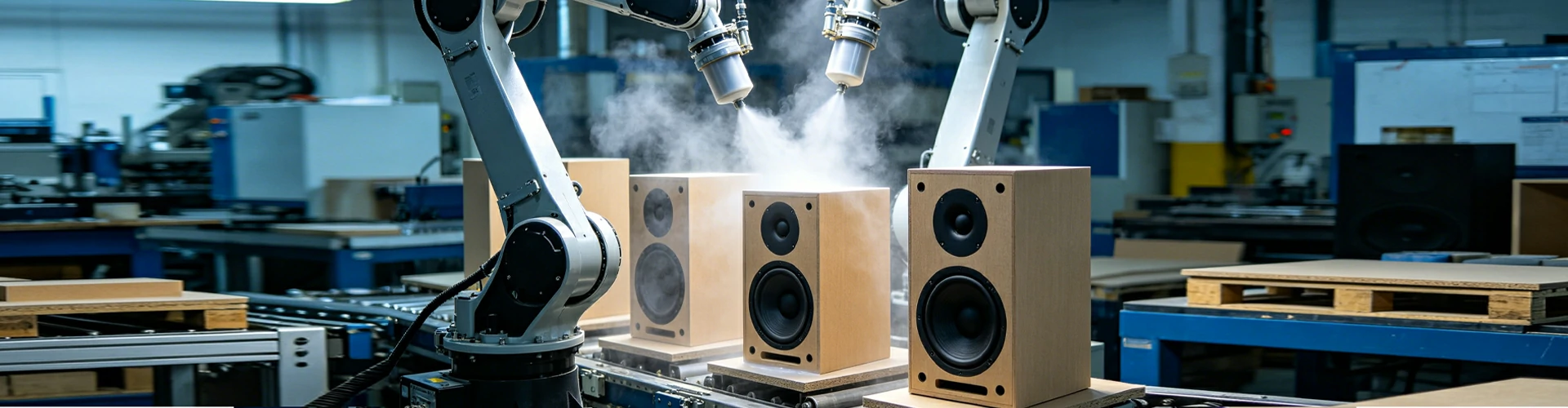
Table of Contents
- Failures in Acoustic and Structural Integrity
- Material Compatibility and Cosmetic Defects
- Manufacturing Bottlenecks and Process Inefficiencies
- Procurement and Supply Chain Risks
- Application Scenarios: Matching Adhesives to Audio Products
- Supplier Selection: Evaluating a Speaker Adhesive Partner
- Conclusion
1. Failures in Acoustic and Structural Integrity
Structural failures directly impact the sound quality and lifespan of the speaker. These issues usually stem from a mismatch between the adhesive’s physical properties and the dynamic stress of audio generation.
Question 1. Weak Bonding Strength in Internal Driver Components
The internal components of a speaker driver operate under extreme electro-mechanical stress and generate significant heat. When parts like the voice coil, spider, or basket come loose during early product life, manufacturers often assume the glue simply wasn’t “strong enough.” In reality, the failure usually indicates that the adhesive failed to properly wet the metal or composite substrate, or that its thermal shear strength degraded under high operating temperatures. To resolve this, production engineers must specify adhesives engineered with high thermal resistance and surface-specific wetting agents, ensuring the chemical bond can transfer kinetic energy from the magnet through the frame without shearing.
Question 2. Adhesive Failure Under Continuous Low-Frequency Vibration
Subwoofers and professional loudspeakers generate aggressive, continuous low-frequency sound waves. If the applied speaker glue dries completely rigid, it cannot accommodate these relentless micro-movements. Over time, dynamic fatigue causes microscopic stress fractures within the adhesive layer. As these micro-fractures expand, components shift, resulting in localized rattling and severe acoustic distortion. The technical fix requires a vibration resistant adhesive for speakers. These specific formulations remain slightly viscoelastic after full curing, allowing the bond line to act as a micro-shock absorber that dissipates kinetic energy rather than fracturing.
Question 3. Speaker Cabinet Joints Separating After Assembly
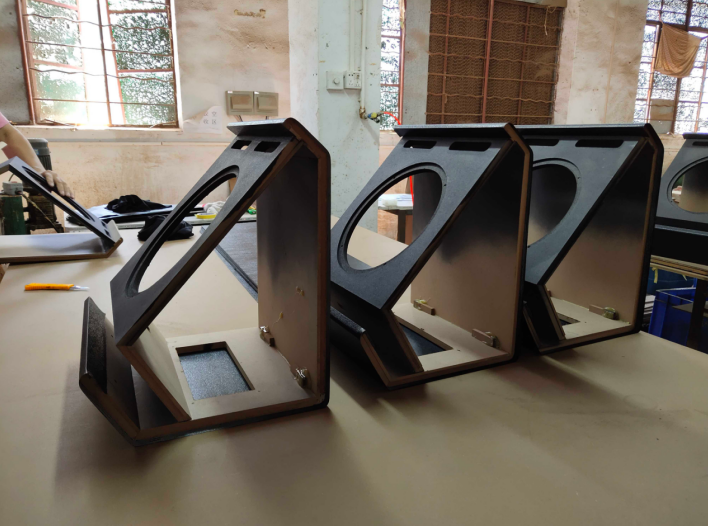
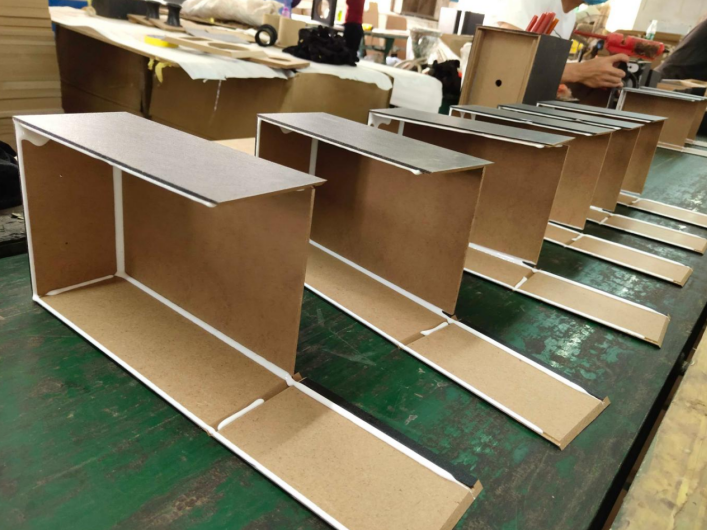
A premium speaker box acts as a pressurized acoustic chamber. When assembling MDF, plywood, or composite panels, a common manufacturing defect is joint separation after the clamps are removed. Because MDF is exceptionally porous, standard woodworking glues often penetrate too deeply into the wood fibers. This leaves a “starved joint” with no adhesive remaining on the surface to actually bond the two panels together. To prevent this, a dedicated speaker cabinet adhesive must be formulated with optimal gap-filling capabilities and controlled penetration. This locks the wood fibers securely while leaving a robust bond line that creates an airtight acoustic seal, completely preventing air leaks (commonly known as chuffing).
2. Material Compatibility and Cosmetic Defects
Modern speaker designs incorporate a mix of woods, plastics, metals, and textiles. Forcing a single adhesive to bond all these materials often leads to delamination and aesthetic ruin.
Question 4. Poor Adhesion Across Dissimilar Materials
An assembly line might bond ABS plastic bass reflex ports to an MDF cabinet or attach a heavy metal grille to a plastic housing. Traditional glues fail here because they cannot chemically grip low-surface-energy plastics, nor can they handle the mismatched thermal expansion rates of plastic and metal. Attempting to alter your production process to fit a generic glue rarely works. Instead, the solution is to source hybrid polymer formulations or adhesives with specialized tackifiers. These advanced adhesives mechanically lock into porous wood grain while chemically biting into smooth plastics, maintaining a secure joint even as temperatures fluctuate.
Question 5. Polymer Cracking from Environmental Shock
While vibration failure occurs during operation, post-cure cracking often happens before the speaker even reaches the consumer. If an adhesive’s Shore hardness is too high, it becomes completely brittle in cold environments. When subjected to the thermal cycling of a shipping container or the heavy mechanical shock of transportation, the rigid glue line shatters. Particularly for automotive interior speakers or touring PA systems, selecting a formulation with a wider operating temperature window and high impact resistance prevents environmental micro-cracking.
Question 6. Delamination and Bleed-Through on Decorative Veneers
For home audio and premium wooden speaker cabinets, visual perfection is mandatory. Delamination of PVC foils, real wood veneers, or acoustic fabrics ruins the product’s premium market value. These failures usually result from adhesives reacting poorly with the veneer backing or containing too much water, which causes thin panels to warp. To ensure flawless cosmetic finishes, manufacturers should utilize dedicated surface-finishing adhesives that feature rapid-setting properties to lock laminates in place before they shift, combined with non-staining, low-moisture chemical profiles to preserve delicate wood grains.
3. Manufacturing Bottlenecks and Process Inefficiencies
Even if an adhesive holds components together perfectly, it can still be considered a failure if it slows down your production line or complicates assembly.
Question 7. Slow Curing Profiles Bottlenecking Press Cycles
In high-volume OEM/ODM audio factories, an adhesive that requires an excessively long clamping or drying time dictates the speed of the entire production floor. This bottleneck forces manufacturers to allocate massive amounts of floor space to drying racks, artificially inflating Work-in-Progress (WIP) inventory and reducing daily output. Adhesive curing speeds should dictate machine settings, not the other way around. By collaborating with a chemical manufacturer, factories can dial in an exact curing profile—ensuring operators have just enough open time to align complex cabinet geometries, but triggering a rapid cure the moment the cabinet enters a hot or cold press.
Question 8. Adhesive Overflow and Precision Dispensing Issues
Applying excess adhesive, or using a formulation that is too thin, leads to squeeze-out when tight-fitting components are mated. Inside the driver, a single drop of overflow can ruin the tight tolerances of a voice coil gap. On the cabinet exterior, dried overflow requires costly manual scraping and can ruin subsequent painting processes. The engineering solution relies on thixotropic (shear-thinning) properties. A properly formulated industrial Speaker Adhesive flows smoothly under the mechanical pressure of a robotic dispensing nozzle, but instantly recovers its high viscosity the moment it touches the substrate. This prevents slumping, stringing, and dripping.
4. Procurement and Supply Chain Risks
Adhesive problems aren’t limited to the factory floor; they often originate in the supply chain when procurement teams prioritize unit cost over chemical consistency.
Question 9. Inconsistent Batch Performance Disrupting Automation
For industrial buyers, supply chain stability is just as critical as chemical performance. If an adhesive supplier lacks stringent raw material controls, the resulting batch variations will wreak havoc on automation. A batch that is slightly too thick will clog dispensing nozzles; a batch that is too thin will cause messy overflow. Procurement managers should avoid basic chemical traders and partner directly with primary manufacturers who implement rigorous quality control procedures. This guarantees that every tote or drum behaves identically on your production line, eliminating the need for daily machine recalibrations.
Question 10. The Risk of Using a Single “All-Purpose” Formulation
Attempting to consolidate factory chemical inventory by using a single glue across the entire speaker assembly is a costly mistake. An adhesive for speaker assembly designed to hold an MDF cabinet together will degrade when applied to a high-heat voice coil, while a rigid structural glue will snap if used to mount a flexible rubber surround. Implementing a material-specific adhesive strategy is the only way to ensure long-term product reliability.
| Audio Component | Primary Materials Bonded | Critical Adhesive Requirement | Consequence of Incorrect Selection |
| Voice Coil & Magnet | Copper, Metals, Composites | Extreme thermal resistance, high shear | Coil detachment, immediate speaker failure |
| Cone & Surround | Paper, Rubber, Treated Fabric | High dynamic flexibility, fatigue resistance | Tearing, buzzing, acoustic distortion |
| Speaker Cabinet | MDF, Plywood, Solid Wood | Gap-filling, controlled penetration | Air leaks (chuffing), joint separation |
| Decorative Veneer | PVC foil, Real Wood Veneer | Fast tack, low-moisture, non-staining | Bleed-through stains, peeling, panel warping |
| External Housings | ABS, PC Plastic | Low surface energy adhesion, impact strength | Housings cracking or snapping open upon impact |
5. Application Scenarios: Matching Adhesives to Audio Products
Different acoustic products require tailored adhesive strategies based on their physical scale, material composition, and the specific demands of their manufacturing environments.
- Professional Loudspeakers & Subwoofers: Building high-wattage PA systems requires prioritizing structural integrity. The adhesive must handle massive internal air pressures and aggressive vibrations. Heavy-duty gap fillers for internal bracing are non-negotiable to ensure the cabinet acts as an impenetrable acoustic vault.
- Bluetooth & Smart Speakers: These products involve compact internal spaces and highly automated electronics assembly lines. The focus here is bonding plastics to metals quickly. Adhesives must offer extremely fast curing profiles and high impact resistance to survive consumer drop testing.
- Headphone and Earphone Assembly: This requires micro-precision. Adhesives must offer exact dispensing capabilities with zero stringing, providing reliable adhesion on millimeter-scale plastic housings without adding excess mass to the delicate acoustic diaphragm.
6. Supplier Selection: Evaluating a Speaker Adhesive Partner
To permanently eliminate adhesive failures, procurement teams must transition from buying off-the-shelf chemicals to partnering with a consultative manufacturer. Evaluate potential suppliers based on their engineering depth.
A reliable supplier will analyze why your current process is failing—differentiating between thermal shock and vibration fatigue—before recommending a solution. True manufacturers can tweak viscosity, adjust curing speeds, and modify flexibility to perfectly align with your existing pressing machines and robotic dispensers. Furthermore, look for partners who offer comprehensive sample testing, material compatibility analysis, and process optimization support prior to full-scale mass production, while demonstrating the supply chain capacity to maintain stable lead times during your peak OEM/ODM production schedules.
7. Conclusion
Adhesive failures in speaker manufacturing are predictable engineering problems, not random occurrences. Whether dealing with cabinet joint separation, driver component detachment, or automated dispensing bottlenecks, the root cause almost always points back to using an improperly matched or low-quality formulation. By understanding the distinct material dynamics and vibration challenges of audio production, manufacturers can dramatically reduce defect rates. The most effective strategy is to partner with a specialized Speaker Adhesive manufacturer capable of providing customized, vibration-resistant, and batch-consistent solutions engineered specifically for your factory’s assembly lines.
Looking for a reliable Speaker Adhesive solution for your audio manufacturing process? Konsent provides adhesive solutions for speaker driver assembly, speaker cabinet bonding, and audio equipment manufacturing. Contact us to discuss your materials, production requirements, and bonding challenges.
Frequently Asked Questions (FAQs)
Why do MDF speaker cabinets require specialized adhesives instead of standard wood glue?
Standard wood glue is often too thin for highly porous MDF, absorbing deep into the wood and leaving a “starved” joint with no adhesive on the surface. Specialized speaker cabinet adhesives possess controlled penetration and gap-filling properties, ensuring a strong physical bond and a perfectly airtight acoustic seal.
How do I stop speaker internal components from rattling loose over time?
Component rattling is typically caused by rigid glues that crack under dynamic fatigue. Upgrading to a vibration-resistant speaker adhesive with elastomeric properties allows the bond line to flex slightly, absorbing the kinetic energy of low-frequency sound waves without fracturing.
What causes adhesive bleed-through when applying wood veneers to speakers?
Bleed-through occurs when an adhesive contains too much moisture, has a viscosity that is too low, or is subjected to excessive press pressure. Using a fast-setting, low-moisture industrial adhesive designed specifically for decorative surface lamination prevents seepage through porous wood grains.
Is it possible to use one type of adhesive for an entire speaker assembly?
No. Different parts of a speaker have conflicting requirements. A voice coil requires high heat resistance, an MDF cabinet needs thick gap-filling properties, and a rubber surround needs extreme flexibility. Using a single “all-purpose” adhesive inevitably leads to localized structural or acoustic failures.
Why is batch-to-batch consistency so critical in audio equipment manufacturing?
In automated manufacturing, slight variations in an adhesive’s viscosity or curing speed will disrupt robotic dispensing and pressing cycles. Consistent batch quality from a reliable manufacturer eliminates the need to constantly recalibrate machinery, drastically reducing downtime and product defect rates.