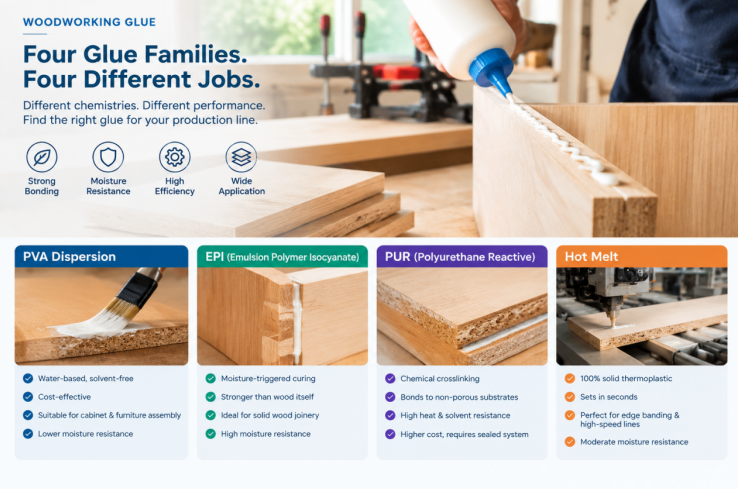
Two product lines on the KONSENT shelf both carry the letters “PUR,” yet they could not be more different on the factory floor. Liquid PUR adhesive ships as a one-component, moisture-curing liquid; PUR hot melt adhesive ships as solid reactive hot melt that you melt before use. Both deliver the same end benefit—a waterproof, heat- and chemical-resistant bond—but the equipment, line speed, and best-fit processes are not the same. This guide compares liquid PUR vs PUR hot melt adhesive so you can match the chemistry to your actual production line. For the wider picture on buying adhesives in bulk, see our wholesale woodworking adhesives guide.
On this page:
- 1. What Is Liquid PUR Adhesive?
- 2. What Is PUR Hot Melt Adhesive?
- 3. Liquid PUR vs PUR Hot Melt at a Glance
- 4. Which Fits Your Process?
- 5. Equipment and Line Speed
- 6. Cost, MOQ and Storage
- 7. KONSENT Liquid PUR and PUR Hot Melt Options
- 8. FAQ
1. What Is Liquid PUR Adhesive?
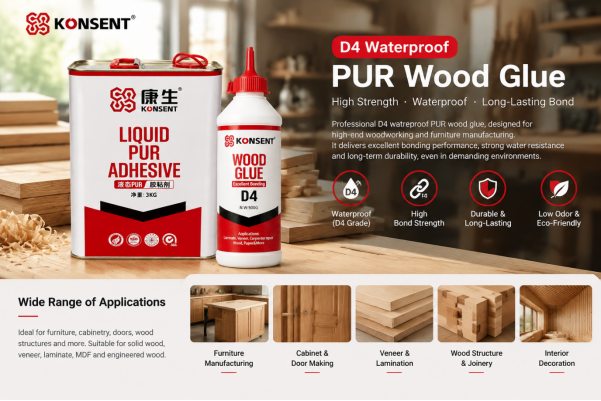
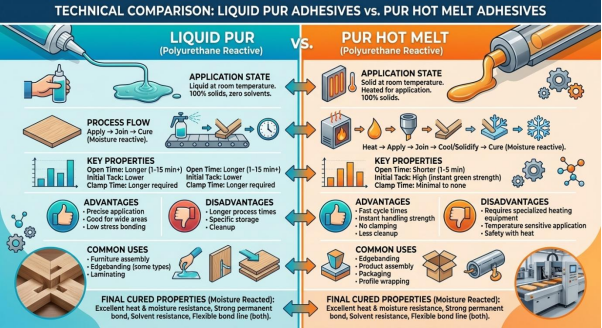
Liquid PUR adhesive is a one-component, moisture-curing polyurethane supplied as a liquid (typically 100% solids or a low-solvent blend). You apply it cold—through a roller coater, a spray gun, a bead dispenser, or a syringe—and it cures by reacting with ambient humidity in the wood and air. There is no heat stage in application, which keeps the line simpler and protects heat-sensitive substrates and films.
Because it goes on as a liquid film, it spreads into a thin, even layer and fills minor surface irregularities. That makes it a strong fit for flat lamination (veneer or decorative paper onto panels), panel-to-panel bonding, and large-surface assembly where you need full coverage without a hot melt tank. Full product details are on the liquid PUR adhesive page.
2. What Is PUR Hot Melt Adhesive?
PUR hot melt adhesive is a reactive hot melt: a solid polyurethane that you melt in a dedicated PUR melter (usually 100–140 °C) and apply as a hot bead or film. It sets almost instantly as it cools—giving immediate “green strength” with no clamping—and then continues to cure chemically as it absorbs moisture over the following hours and days.
That instant set is why it dominates edge banding, profile wrapping, and 3D membrane pressing, where you cannot wait for a liquid to cure before moving the part. The trade-off is the melter: you need PUR-compatible heated equipment and good temperature control. See the PUR hot melt adhesive page for grades and packaging.
3. Liquid PUR vs PUR Hot Melt at a Glance
| Property | Liquid PUR | PUR Hot Melt |
|---|---|---|
| Form at room temperature | Liquid (1K) | Solid pellet or block |
| Application temperature | Ambient (no heating) | 100–140 °C in a melter |
| Set mechanism | Moisture cure (hours) | Physical cool-down (seconds) plus moisture cure |
| Green strength | Develops over hours | Immediate on cooling |
| Best processes | Flat lamination, panel bonding | Edge banding, profile wrapping, 3D lamination |
| Equipment barrier | Low (roller, spray, bead) | Higher (PUR melter required) |
| Heat-sensitive films | Safer (no heat) | Needs temperature control |
4. Which Fits Your Process?
Match the adhesive to the dominant operation on your line, not to the brochure:
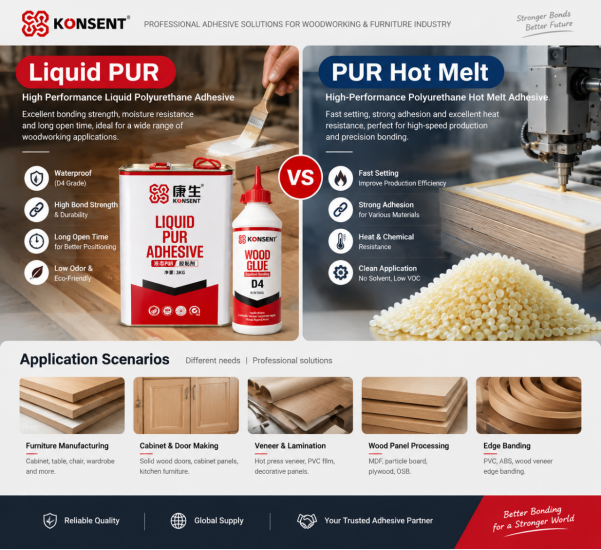
- Edge banding and profile wrapping: choose PUR hot melt. The instant set lets parts move immediately, and the thin hot-melt line stays nearly invisible on PVC and ABS edges.
- Flat lamination (veneer, paper, foil onto panels): choose liquid PUR for even, bubble-free coverage across large sheets without a melter.
- Panel-to-panel and large-surface assembly: liquid PUR fills gaps and needs no heat, which suits carcass and door bonding.
- Mixed lines: many factories run both—hot melt for edges, liquid for surfaces—because the two chemistries share the same final waterproof performance.
5. Equipment and Line Speed
PUR hot melt wins on line speed. Once the melter is at temperature, a bead or roller applies in a single pass and the part is handled seconds later—ideal for high-volume edge banding. The cost is capital: a PUR-compatible melter, heated hoses, and strict temperature control to avoid scorching.
Liquid PUR needs no melter, so the entry cost is lower and retrofitting an existing roller coater or dispenser is straightforward. The trade-off is cure time: parts need fixture or dwell time (hours) before full strength, which can bottleneck a fast line unless you plan floor space for curing.
6. Cost, MOQ and Storage
Per-kilogram adhesive price is similar between the two, but total cost of ownership differs:
- Equipment amortization: hot melt carries melter cost; liquid PUR rides on equipment you may already own.
- Yield: thin liquid films can use less adhesive per square meter on flat work; hot melt’s precision beads reduce waste on edges.
- Storage: liquid PUR is moisture-sensitive in the container and has a shelf life—keep drums sealed. Hot melt solid is more stable in storage but must be kept dry and cool.
- MOQ: both are available from 500 g samples up to 200 kg drums and IBC totes for bulk runs.
7. KONSENT Liquid PUR and PUR Hot Melt Options
KONSENT supplies both chemistries to furniture factories, with OEM and private-label options:
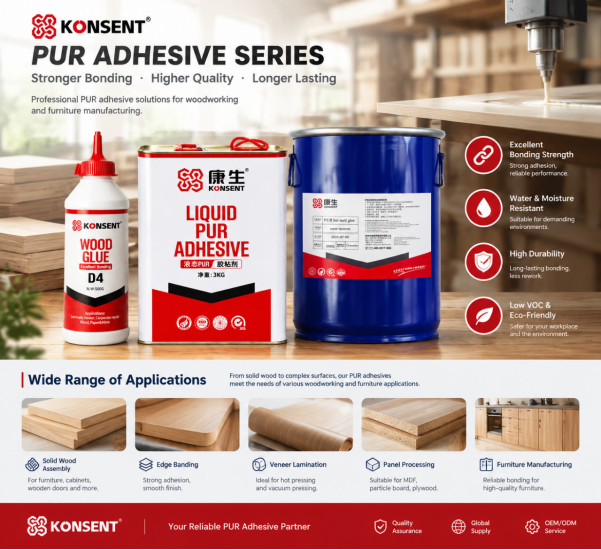
- Liquid PUR adhesive (HS-129 / HS-129NK): one-component, moisture-cured D4-grade PUR, gap-filling, bonds damp (20–60% moisture), oily, and dissimilar substrates such as melamine, HPL, gypsum board, and metal.
- PUR hot melt adhesive: reactive hot melt for edge banding, profile wrapping, and 3D lamination, supplied in 200 kg drums and other formats for automatic lines.
Both lines are detailed in our woodworking furniture adhesives overview, and samples can be tailored to your substrate and line speed.
8. FAQ
Is liquid PUR as waterproof as PUR hot melt?
Yes. Both reach D4-level water resistance once fully cured. The difference is how they are applied and set, not the final waterproof performance.
Do I need a PUR melter for liquid PUR?
No. Liquid PUR applies cold through a roller, spray, or bead dispenser you likely already own. The melter is only required for PUR hot melt.
Which is faster for edge banding?
PUR hot melt. It sets on cooling in seconds, so parts move immediately. Liquid PUR would need fixture time before the joint reaches handling strength.
Conclusion
Choose liquid PUR when you laminate flat surfaces, bond panels, or want a low-equipment-entry waterproof bond. Choose PUR hot melt when speed rules—edge banding, profile wrapping, and 3D lamination where instant set keeps the line moving. Both deliver the same durable, waterproof result, so the decision comes down to your process and equipment. For a full buying checklist, see our wholesale woodworking adhesives guide.
Not sure which fits your line? Contact KONSENT for free samples and a recommendation based on your substrates and output rate.